
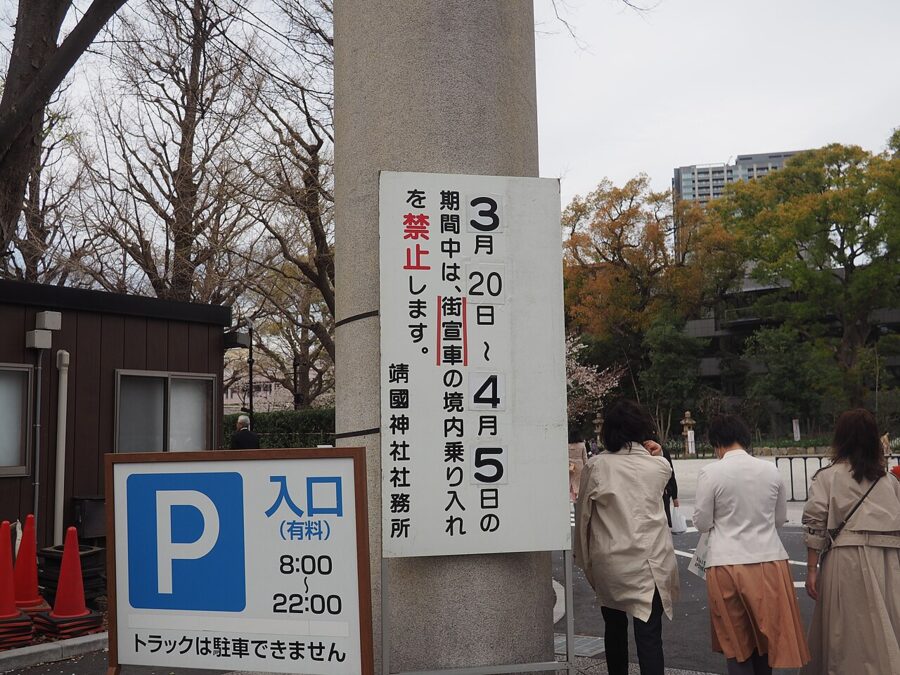

The most watched cherry tree in Japan stands in the grounds of Yasukuni Shrine, and almost nobody who visits could pick it out. It is a Somei-Yoshino, one of hundreds in central Tokyo, and since 1966 it has been the Japan Meteorological Agency’s sample tree for the capital. When an observer from the agency finds five or six open flowers on it, cherry blossom has officially begun in Tokyo. In 2026 that happened on 19 March.
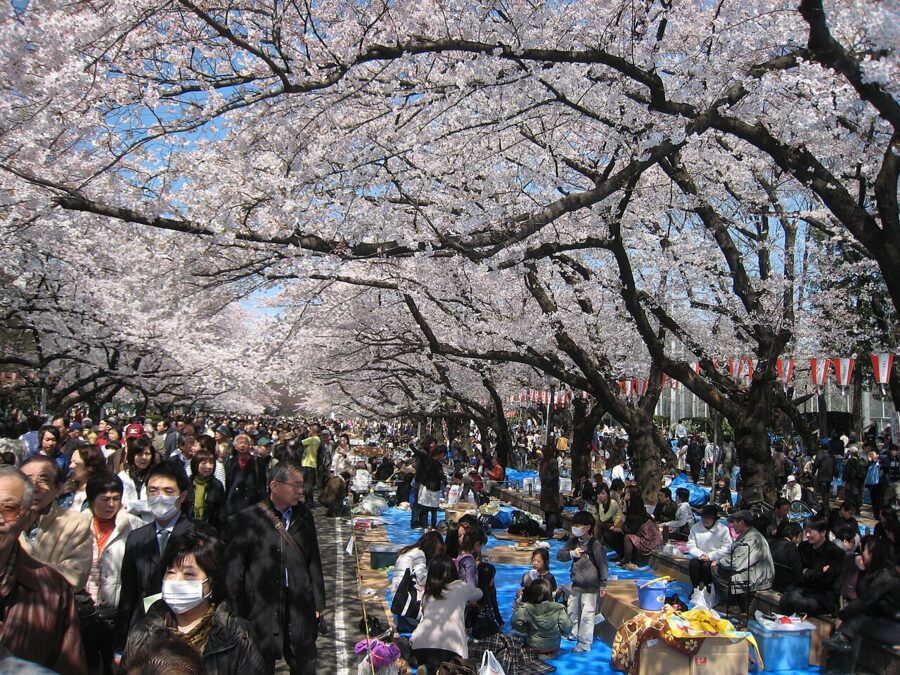
What follows is hanami (花見, “flower viewing”): sitting under cherry trees in bloom, usually with food, usually with drink, often with colleagues you did not choose. The custom runs from a ninth-century palace garden to a blue plastic sheet taped to a park lawn at six in the morning, and most of the rules a visitor meets today were written in the last few years.

In this article
A word that used to mean plum
Hanami is simply hana (flower) and mi (looking). It names no flower, and for the first centuries of written Japanese the flower people meant was the plum, which came from China with Chinese poetry. In the eighth-century Man’yōshū, the plum is the most sung plant after bush clover and well ahead of the cherry, according to the Nihon Kokugo Daijiten.
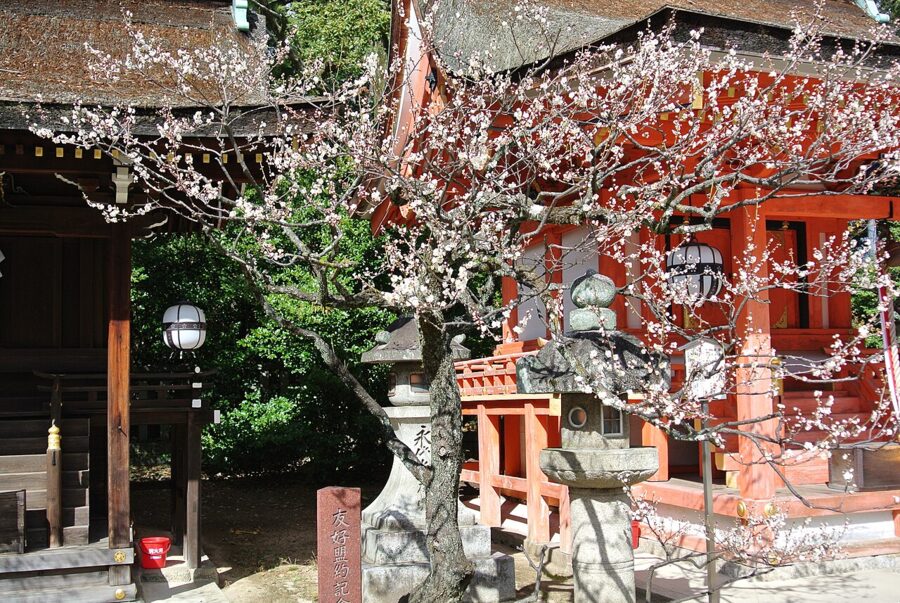

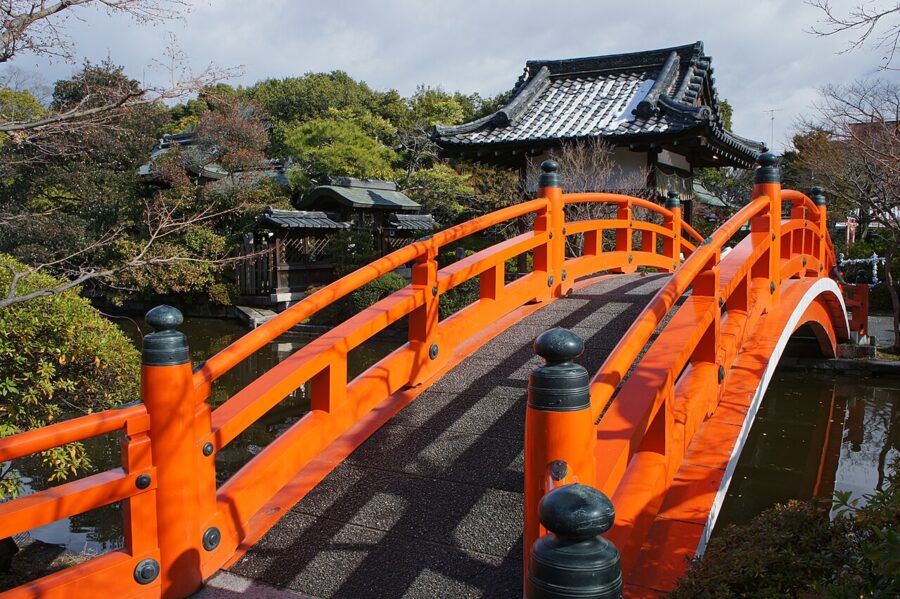
The court changed its mind in the Heian period. The chronicle Nihon Kōki records that on the twelfth day of the second month of 812, Emperor Saga viewed the blossoms at Shinsen-en, the palace pleasure garden, and had his scholars compose poems on them. The Heibonsha World Encyclopedia takes that entry as the start of the hana no en (花宴, “flower banquet”) as a court occasion. A century later, in the Kokinshū anthology, “flower” in a poem meant cherry unless the poet said otherwise.

Villages had their own version: outings to the hills before rice planting, food eaten together outdoors before the farming year began.
Kenko’s grumble and Hideyoshi’s party
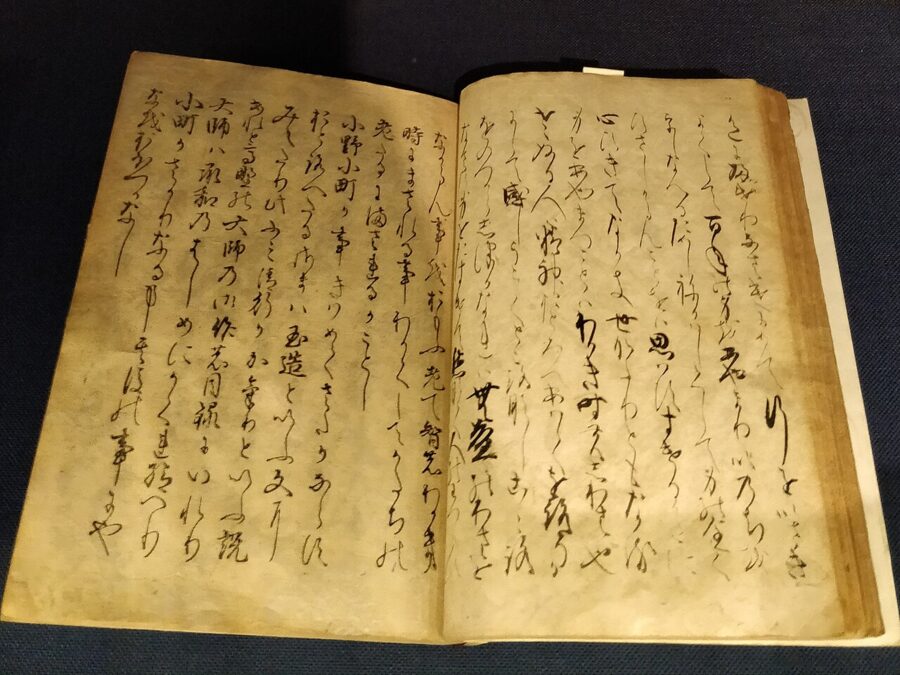
Complaints about behaviour under the trees are nearly as old as the parties. In the fourteenth century the monk Yoshida Kenko wrote in Tsurezuregusa (Essays in Idleness) that refined people enjoyed blossoms with restraint, while country folk pushed in close, drank, composed linked verse and finally broke off big branches without a thought. Swap the linked verse for karaoke and it could be a 2026 notice board.

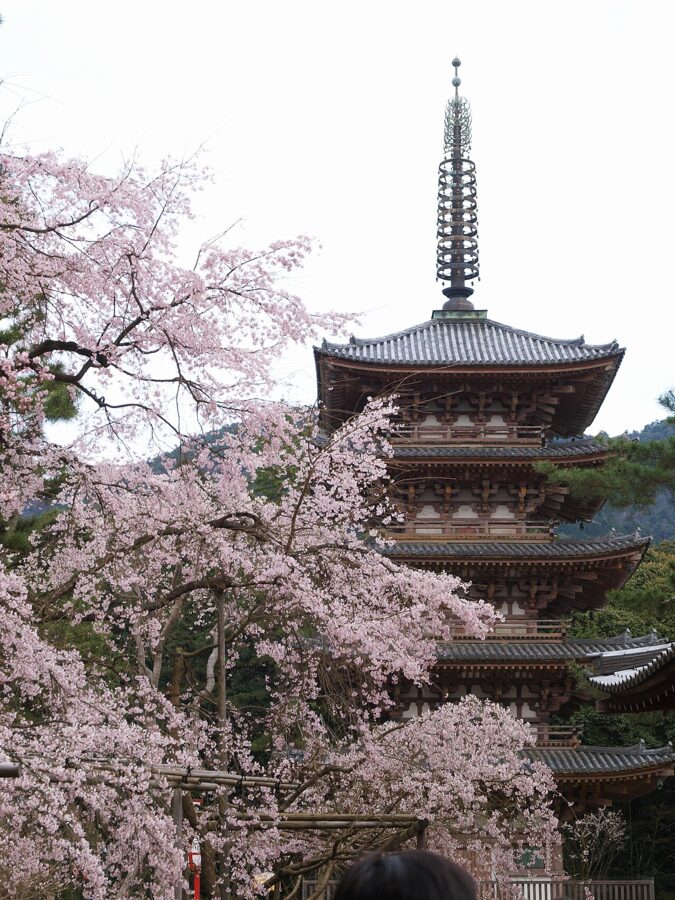
The warrior class made it bigger. The model for every lavish hanami since is the one Toyotomi Hideyoshi held at Daigo-ji, south-east of Kyoto, on the fifteenth day of the third month of 1598. The temple says he had 700 cherry trees brought in from around the capital region and had the Sanbo-in and its garden rebuilt.
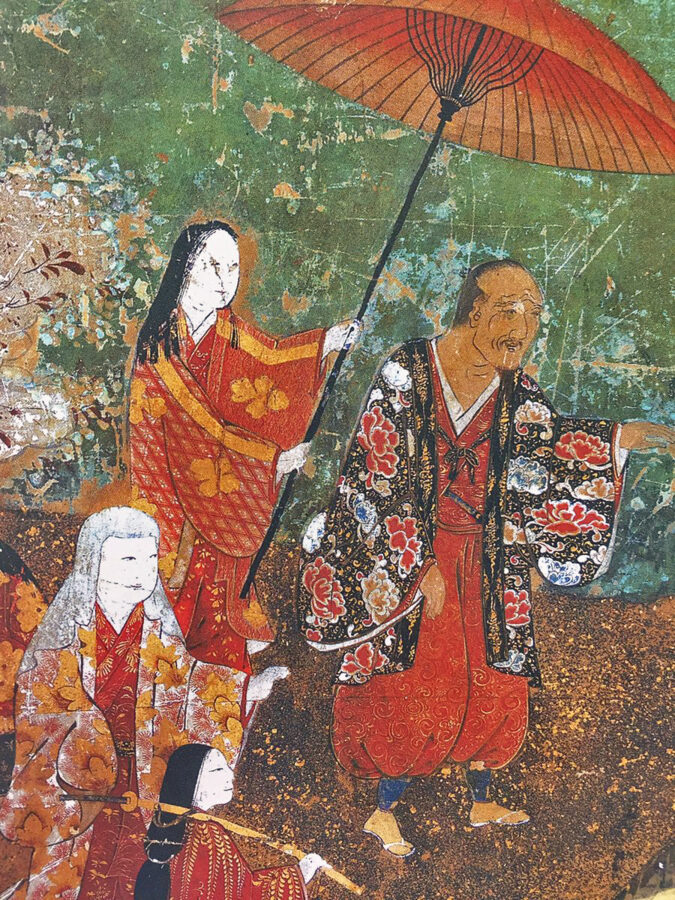
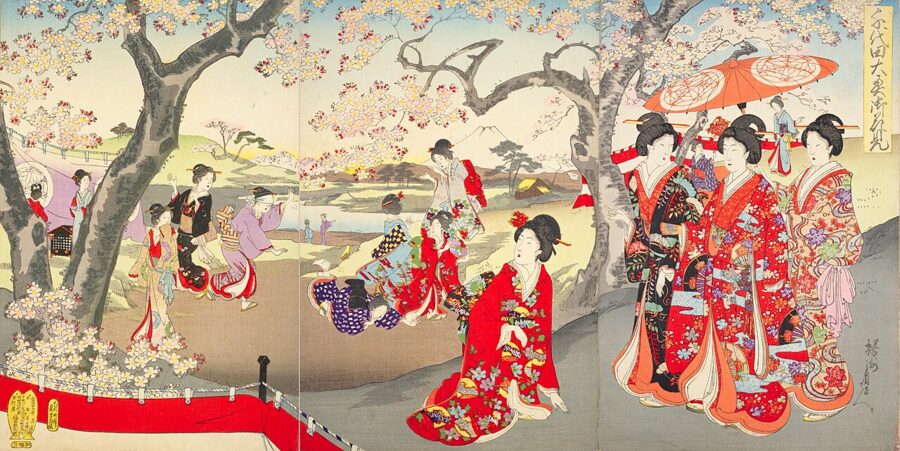
Several hundred guests came: his heir Hideyori, his wife Kita no Mandokoro, his consort Yodo and their attendants, with tea houses along the hillside paths. The Nihonica entry adds that the women’s robes were made in three sets, so they could change twice during the day.
Hideyoshi died five months later. The 131 poem slips written that day are kept at the Sanbo-in, and the temple re-stages the procession as the Hotaiko Hanami Gyoretsu on the second Sunday of April. Daigo-ji cancelled the 2026 parade, so the next chance is April 2027, if it goes ahead.

Edo goes out to picnic
The party became everyone’s in Edo, and the trees came first. Ueno’s cherries go back to Tenkai, the priest who founded Kan’ei-ji there in the seventeenth century and had saplings brought from Mount Yoshino. But Ueno was the shogun’s family temple, and the city needed more room.
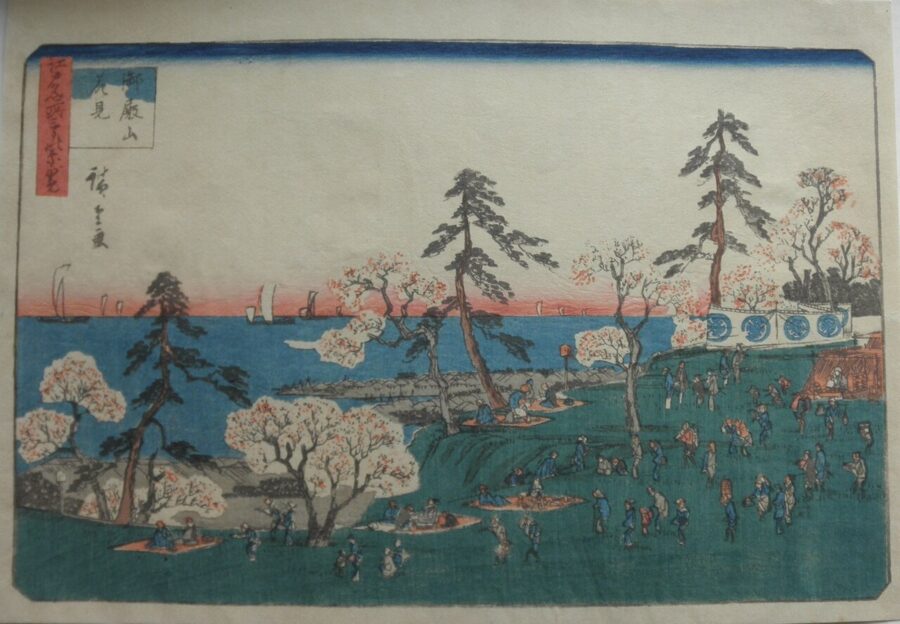
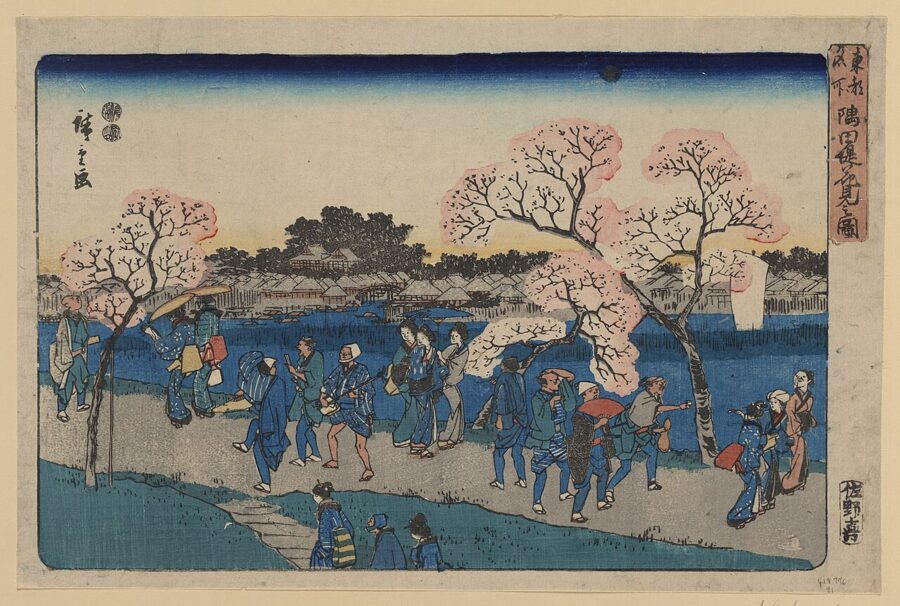
The eighth shogun, Tokugawa Yoshimune, supplied it. Early in his Kyoho reforms he had cherries planted on the Sumida River embankment, at Gotenyama above Shinagawa, and more than a thousand on Asukayama, a low hill north of the city. In 1737 he handed Asukayama to the Oji Gongen shrine and it was opened to the public.
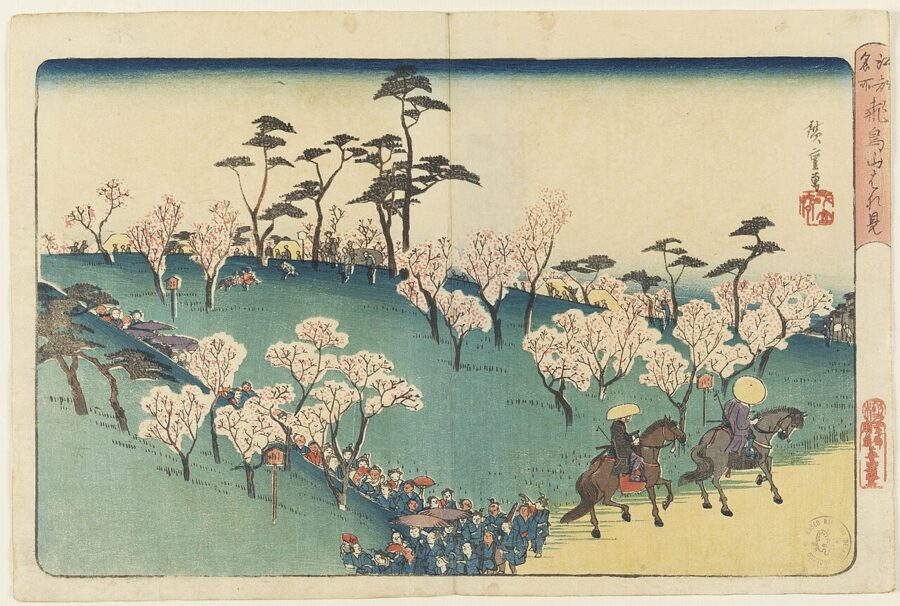
The Ministry of the Environment, which runs Shinjuku Gyoen, says Yoshimune planted to encourage ordinary people’s outings, and that modern hanami starts there. I read it as crowd management with flowers. It worked: people carried lacquered food boxes and sake out to the hills, sat on mats, sang, and the print publishers sold the scene back to them.
The rakugo story Nagaya no Hanami (“Tenement Hanami”) still laughs at the pressure to join in. A landlord marches his broke tenants to Ueno with weak tea for sake and sliced radish for fishcake, and orders them to look drunk.
The tree that defines the season arrived at the end of the period. The Somei-Yoshino is a cross of Edo-higan and Oshima cherry that the agency dates to the late Edo period, sold by nurseries in Somei village, now Komagome, as “Yoshino cherry”. Every tree is a grafted clone. That is why a whole avenue opens on the same few days, and why one tree can stand in for a city.
The tree at Yasukuni, and the forecasters
The agency’s definitions are short. Kaika (開花, “opening”) is the first day five or six flowers are open on the sample tree, the hyōhonboku (標本木). Mankai (満開, “full bloom”) is the first day about 80 per cent of the buds are open. Okinawa and Amami watch the hikan cherry instead, and parts of Hokkaido the Ezo mountain cherry.
The agency’s Tokyo office thinks it lost the tree in its own grounds when it moved offices within Chiyoda Ward in 1964, and found Yasukuni’s two years later. Records under a single method begin in 1953.
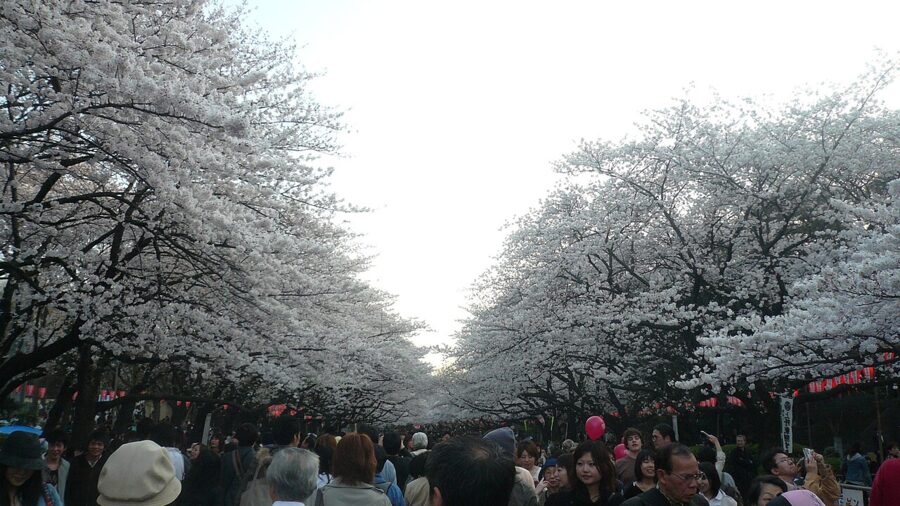

What the agency no longer does is forecast. It issued cherry forecasts from 1955 and on 25 December 2009 announced it would stop, because private forecasters were already publishing the same thing. The forecasts on television and in apps now come from companies such as Weathernews and the Japan Weather Association, and they do not always agree.
The 2026 season ran early. These are the agency’s observed dates against the 1991–2020 averages:
| Station | Opening 2026 | Average | Full bloom 2026 | Average |
|---|---|---|---|---|
| Tokyo (Yasukuni) | 19 March | 24 March | 28 March | 31 March |
| Kyoto | 23 March | 26 March | 30 March | 4 April |
| Osaka | 26 March | 27 March | 3 April | 4 April |
| Sendai | 31 March | 8 April | 4 April | 13 April |
| Sapporo | 18 April | 1 May | 24 April | 6 May |
Tokyo’s earliest opening on record is 14 March, in 2020, 2021 and 2023; the latest was 11 April 1984. A cold snap, hanabie (花冷え, “flower chill”), can stretch the bloom. A hard rain after full bloom can strip a tree in a night.
The party: the tarp, the seat-holder, the food
A party starts with basho-tori (場所取り, “taking the spot”). Someone goes early, spreads a sheet and stays on it until the others arrive. In a company that someone is traditionally the newest recruit, and new recruits start in April.
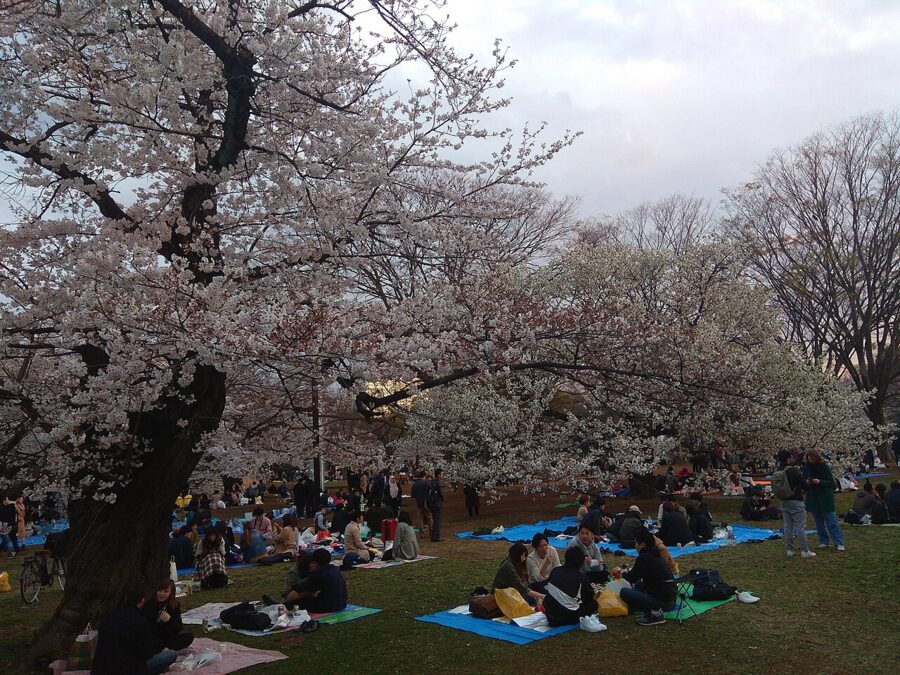

The sheet is almost always a builder’s blue tarpaulin, weighted with bags. Japanese how-to guides add the unglamorous parts: a sleeping bag for an overnight hold, and an eye on the crows.
Overdoing it gets noticed. In 2016 staff from one company covered about 500 square metres with sheets bearing the company name; once the photographs spread online, the company apologised. Paying a stranger to hold a spot is another matter. Hokkaido’s nuisance ordinance, for one, bans selling places in a public space, a trade known as shobaya (ショバ屋).
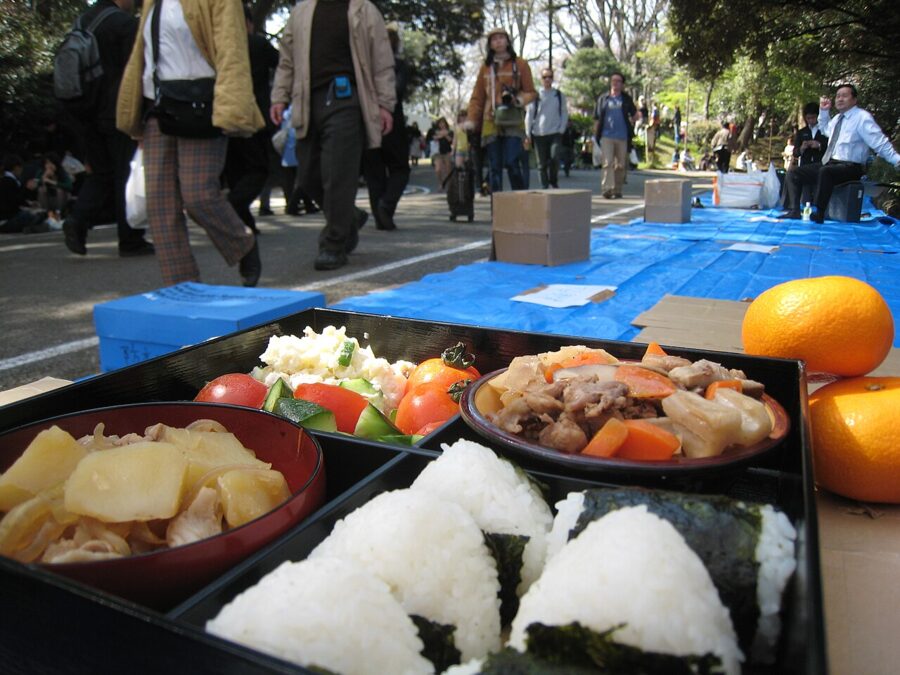
The food is whatever travels: home-packed boxes, convenience-store rice balls, fried chicken, beer and canned highballs. A drink under blossom is hanami-zake (花見酒), and a party that is mostly about the drink earns the proverb hana yori dango (花より団子, “dumplings over flowers”).
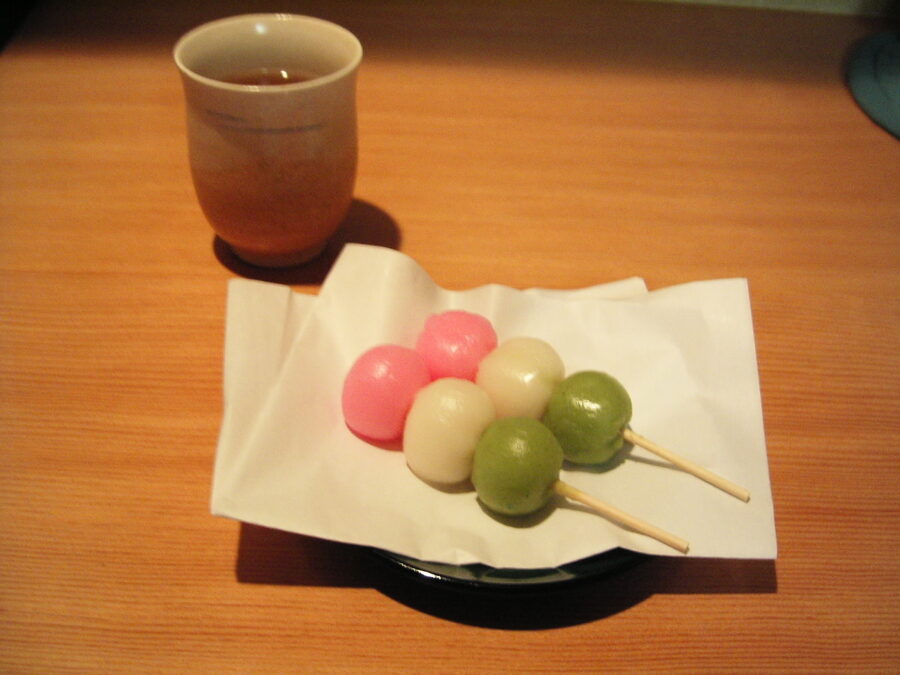

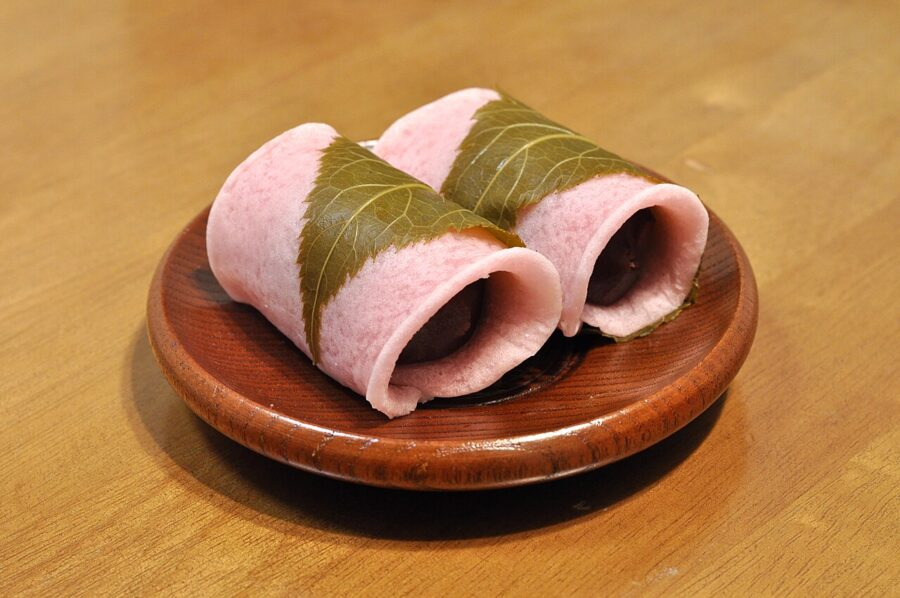
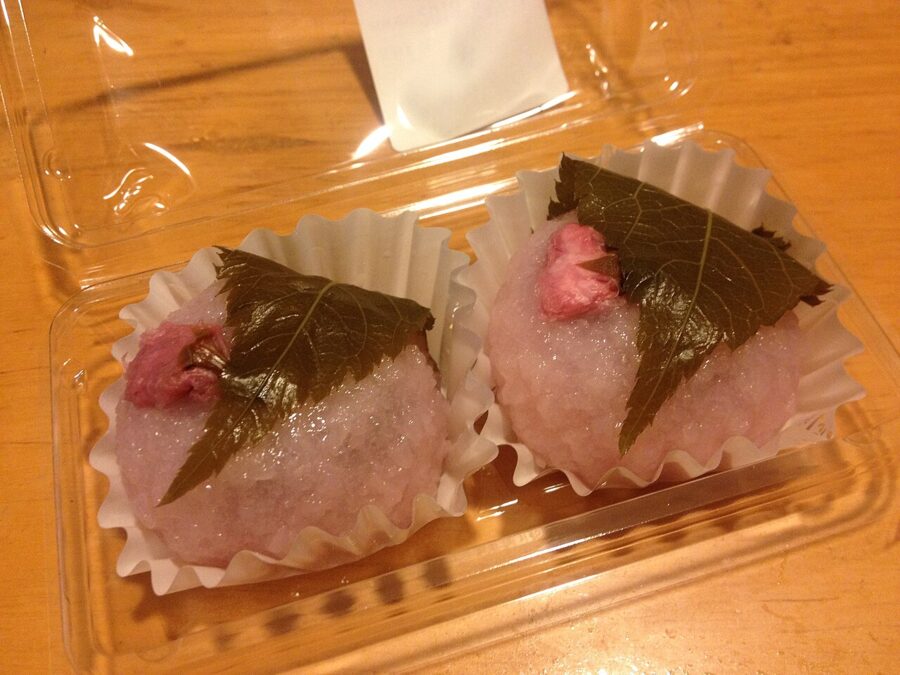
The season’s sweet is sakura mochi, in two kinds that split the country roughly east and west. Tokyo’s Chomei-ji style is a thin pink crepe rolled round bean paste, named after the temple by the Sumida embankment where it is said to have been first sold. Kansai’s Domyo-ji style is coarse steamed rice. Both come in a salted cherry leaf, and eating the leaf is a matter of taste.

Yozakura and the lanterns
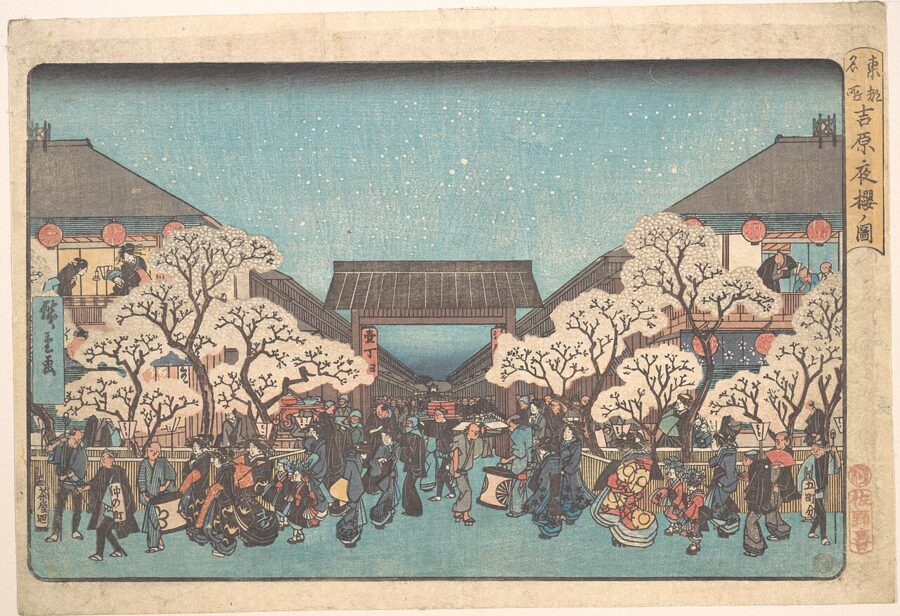
Yozakura (夜桜) is cherry blossom at night. The Daijisen dictionary traces one sense of the word to the Yoshiwara pleasure quarter, where cherries were planted along the main street each spring, fenced with bamboo and lit with bonbori, paper-shaded lamps on posts. Parks now string up the same lamps, often with sponsors’ names on them.
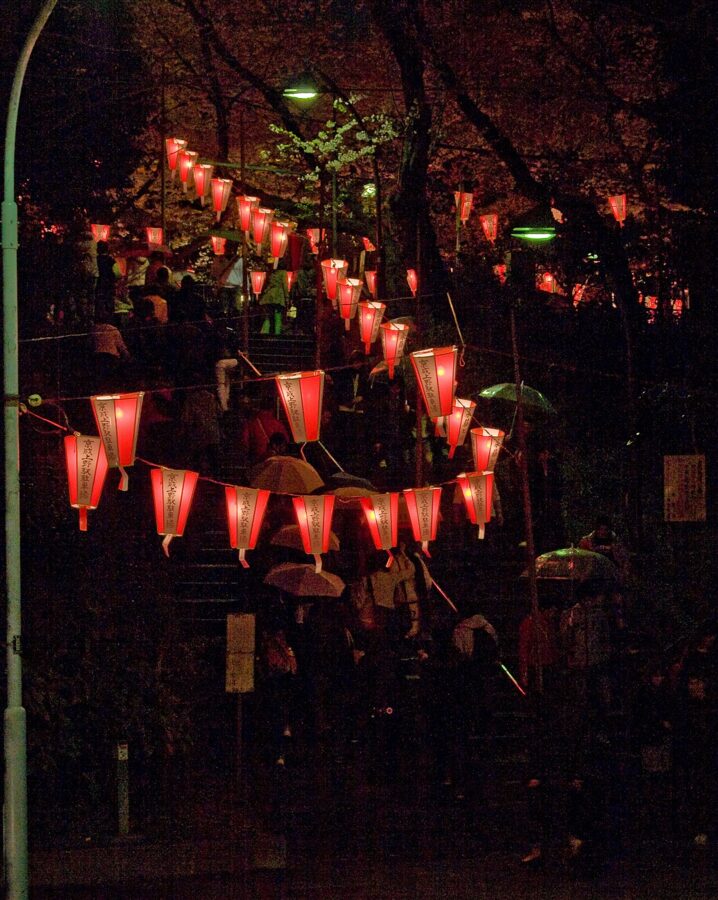

The after-work party under the lanterns is company hanami. The junior holds the spot, the section chief arrives with the boss, and the toasts follow rank. Nobody is obliged to come, and everybody knows how it looks if they don’t: kūki wo yomu (空気を読む), reading the air, applied to a picnic.
The rules the parks set now
Hanami has always come with orders. The Tokyo edition of the Asahi Shimbun on 2 April 1899 printed the police list of costumes to be stopped at the blossom spots: men dressed as women, women dressed as men, anyone in a tengu or demon mask. Paper masks and false beards were allowed.
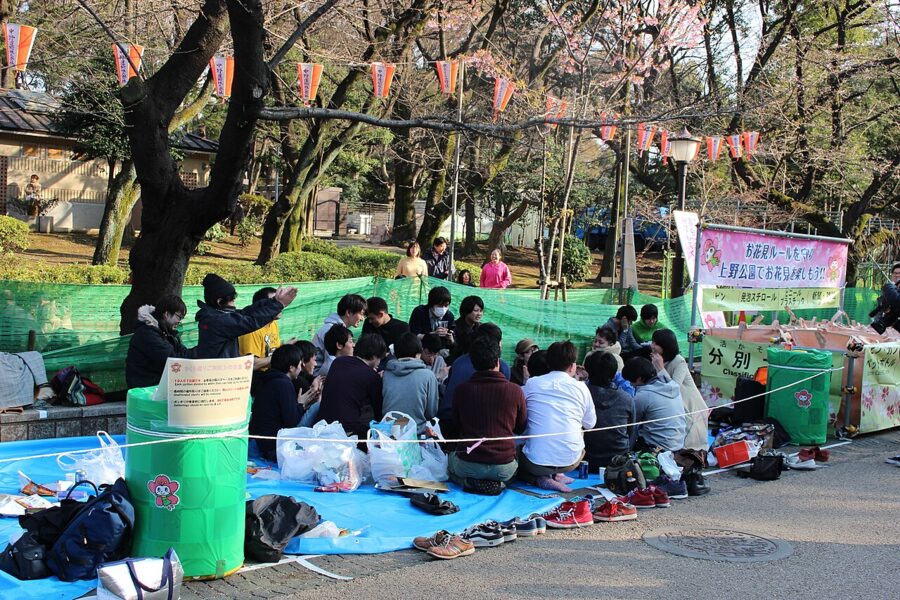
The modern rules came in waves. In 2011, weeks after the Tohoku earthquake, Tokyo governor Shintaro Ishihara (石原慎太郎) called for jishuku (自粛, “self-restraint”) and no drinking parties under the trees. From 2020 to 2022 the pandemic emptied the lawns: Tokyo’s parks roped off the avenues and banned seated parties.
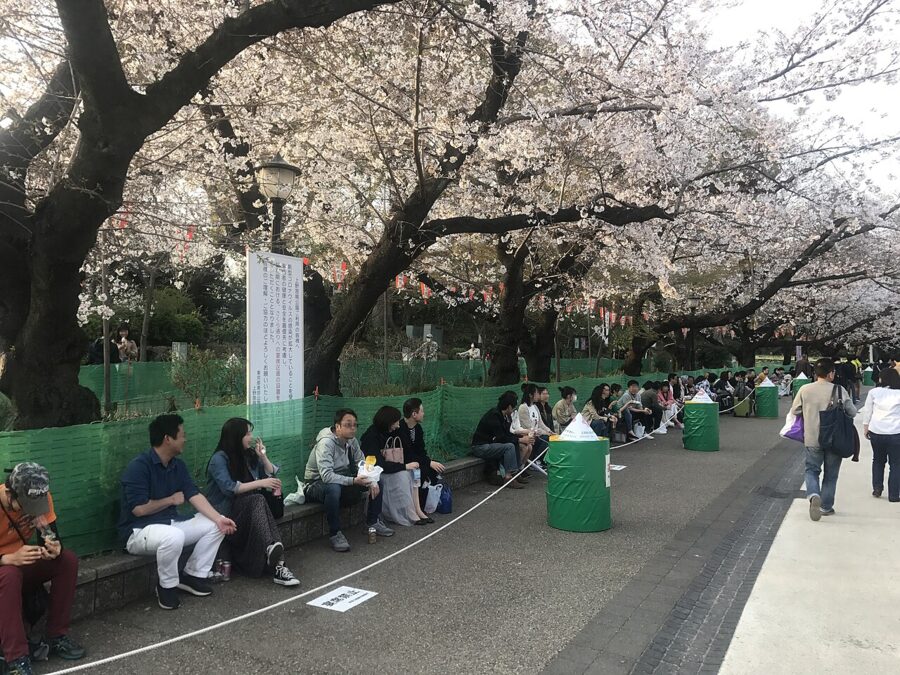

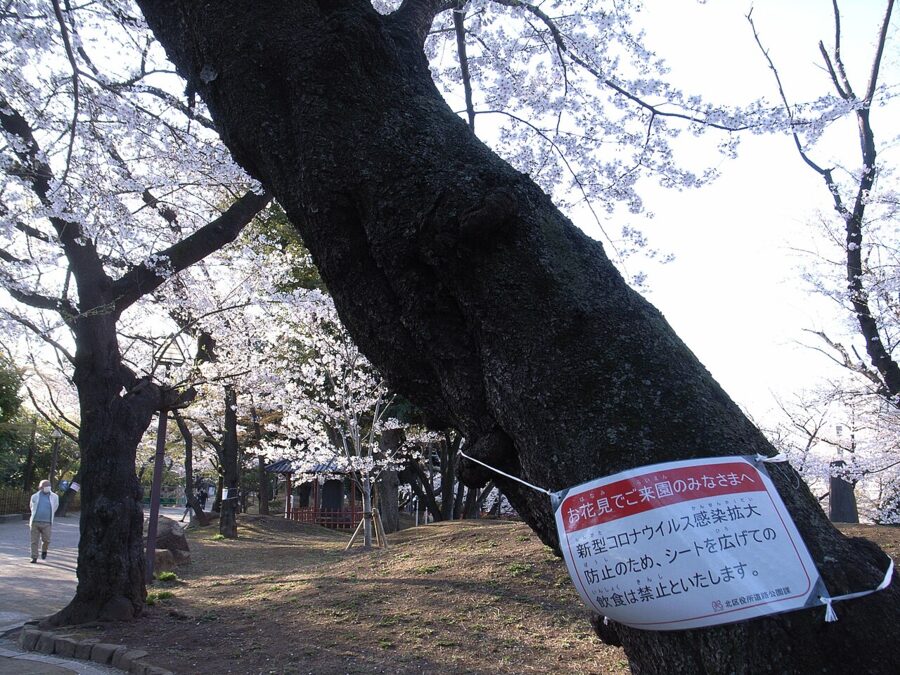

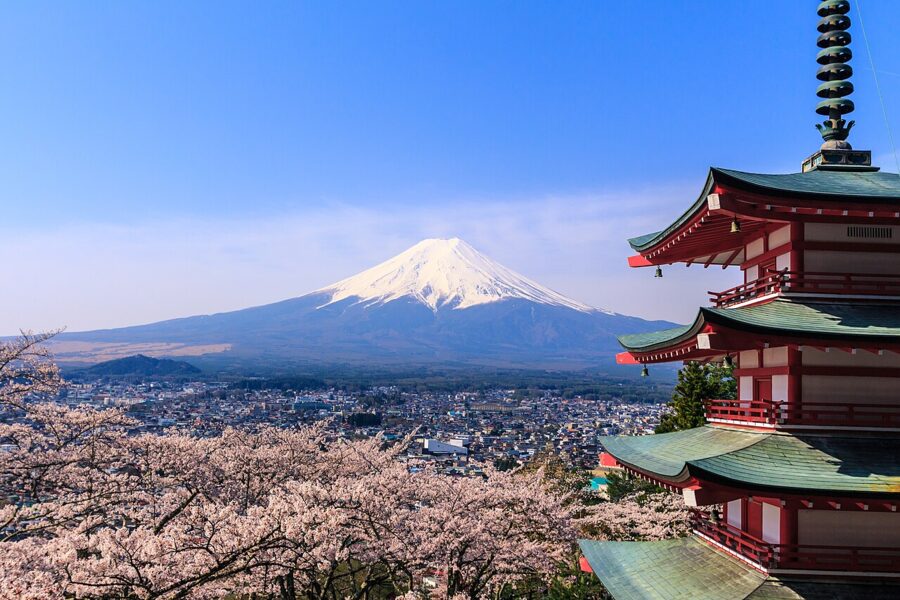
When the sheets came back to Ueno in 2023, for the first time in four years, many limits stayed. Riverside spots that pass through housing now manage crowds rather than parties. Fujiyoshida, below Mount Fuji, went further: in February 2026 it cancelled its cherry festival at Arakurayama Sengen Park outright, saying the crowds had become too much for the neighbourhood.

As of the 2026 season, these were the rules at the best-known spots:
- Ueno Park: the central Sakura-dori avenue is kept for walking, and the park sets its own rules each season on holding spots and on when parties must end, so check its notices; no stoves; rubbish taken home. The park closes from 23.00 to 05.00.
- Shinjuku Gyoen: no alcohol may be brought in, nor household rubbish or ball games.
- Chidorigafuchi: no parties and no smoking on the moat-side path, tripods discouraged, branches not to be touched.
- Meguro River: the ward’s mayor, Eiji Aoki (青木英二), asked visitors in his March 2026 message to hand empty cups back to the stall that sold them, keep the noise down, and follow the guards one way without stopping.
- Maruyama Park, Kyoto: the park office bans claiming a spot in advance with a blue sheet.
Two rules apply everywhere. Don’t touch the trees: no ropes or lanterns on branches, no shaking them for a photo, no pegs in the shallow roots. Gardeners say sakura kiru baka, ume kiranu baka, “a fool cuts a cherry, a fool fails to prune a plum”. And take everything home.
Where to go: Tokyo
Ueno Park
Ueno is the loud one, and worth seeing once. About 1,200 cherry trees stand in the park, according to Taito City, and the 77th Ueno Sakura Festival ran from 14 March to 5 April 2026, with food stalls and an antiques market by Shinobazu Pond. Walk it on a weekday morning; come back on a weekday evening for the parties.
Getting there: JR Ueno Station, Park Exit, two minutes on foot; Keisei Ueno Station is a minute from the south end. Entry is free.
Asukayama and the Sumida
Yoshimune’s two plantings are easier going than Ueno. Asukayama Park sits on its hill beside JR Oji Station. Sumida Park lines both banks of the river at Asakusa, so you can walk one side, cross a bridge and come back down the other.

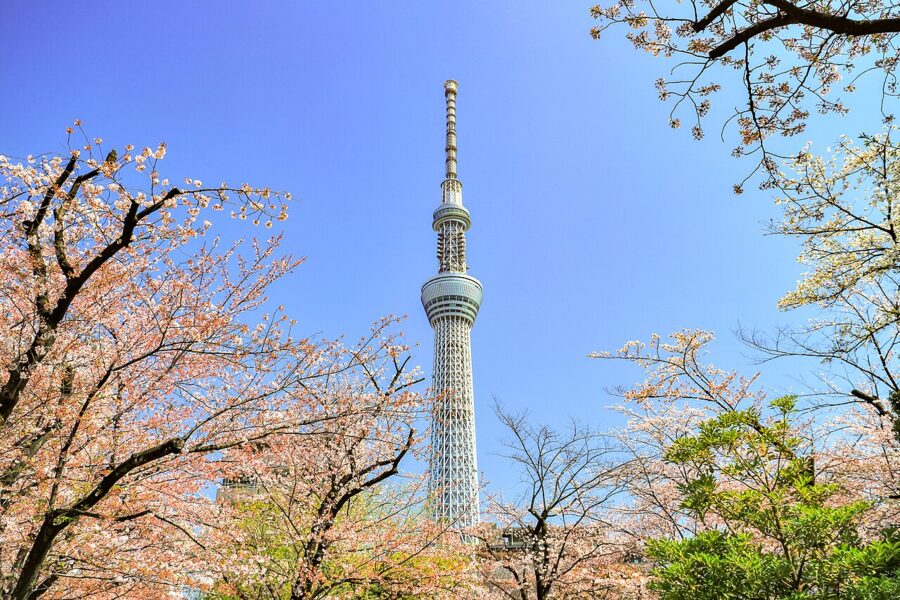

Chidorigafuchi
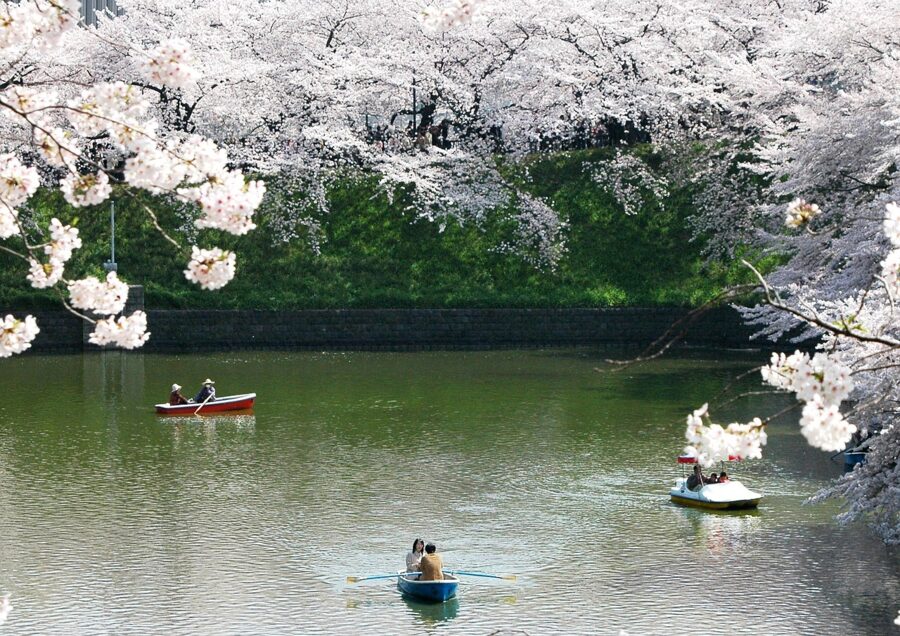
The prettiest spot in the city is a moat. Chidorigafuchi is the north-west curve of the Imperial Palace moat, and the Chidorigafuchi Ryokudo path runs about 700 metres along its rim under trees that lean over the water. In 2026 it was lit from 26 March to 6 April, from sunset (about 18.00) to 21.00, with one-way walking at weekends.
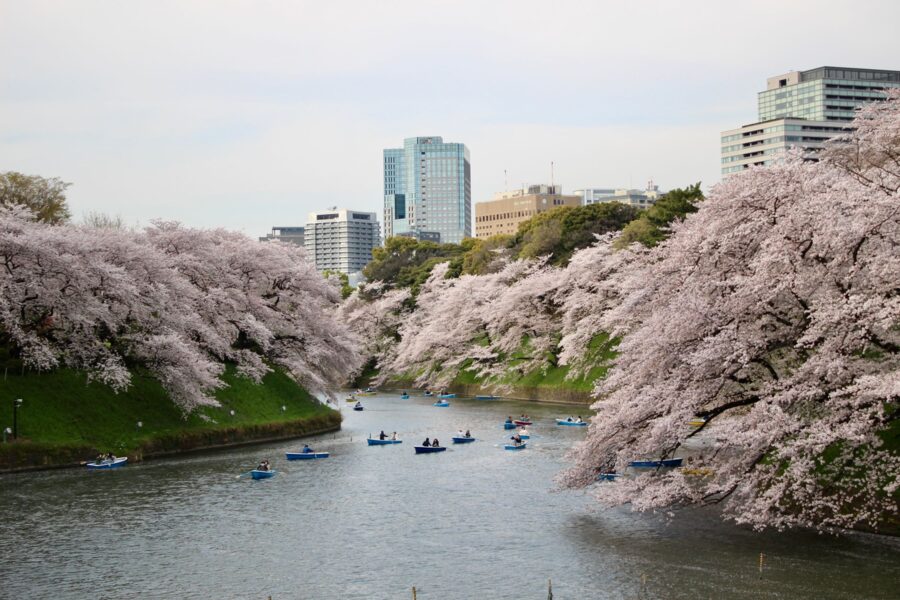
The rowing boats are the draw. During the illuminations the festival office sold advance “smart tickets” at ¥12,000 (about $80) an hour per boat for up to three people, part of it going to the ward’s cherry fund. Same-day tickets are sold at the boathouse to those prepared to queue.
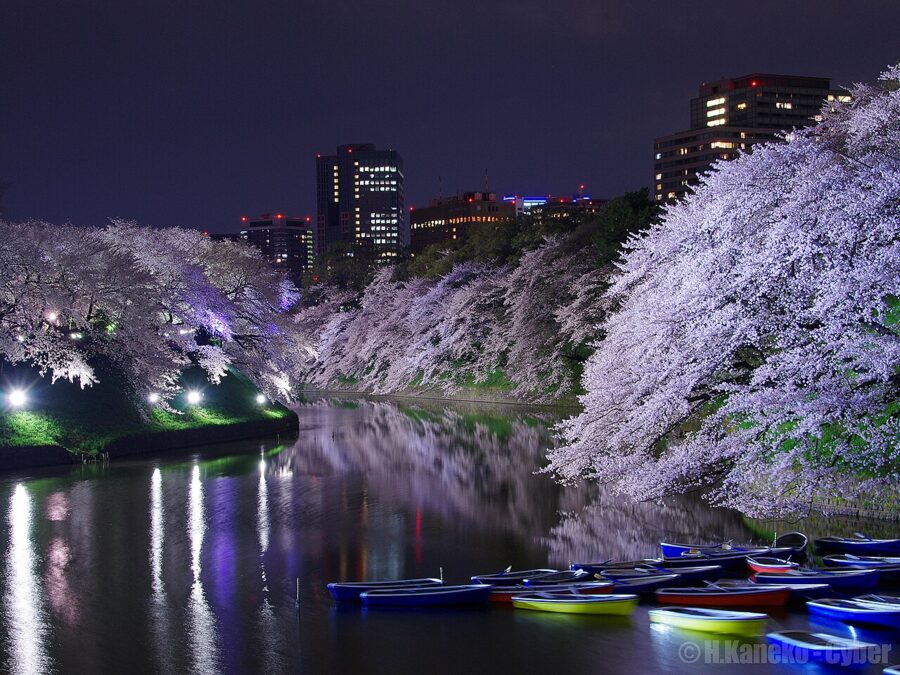

Getting there: Kudanshita Station (Tozai, Hanzomon and Toei Shinjuku lines) for the north end of the path. Yasukuni Shrine, home of the sample tree, is a short walk up Kudan-zaka.
Shinjuku Gyoen
The calm one, thanks to the alcohol ban and the gate. The garden counts about 900 trees of some 70 varieties, around 300 of them Somei-Yoshino, so something is in flower from the early kanzakura in February to the double yaezakura in mid-April.
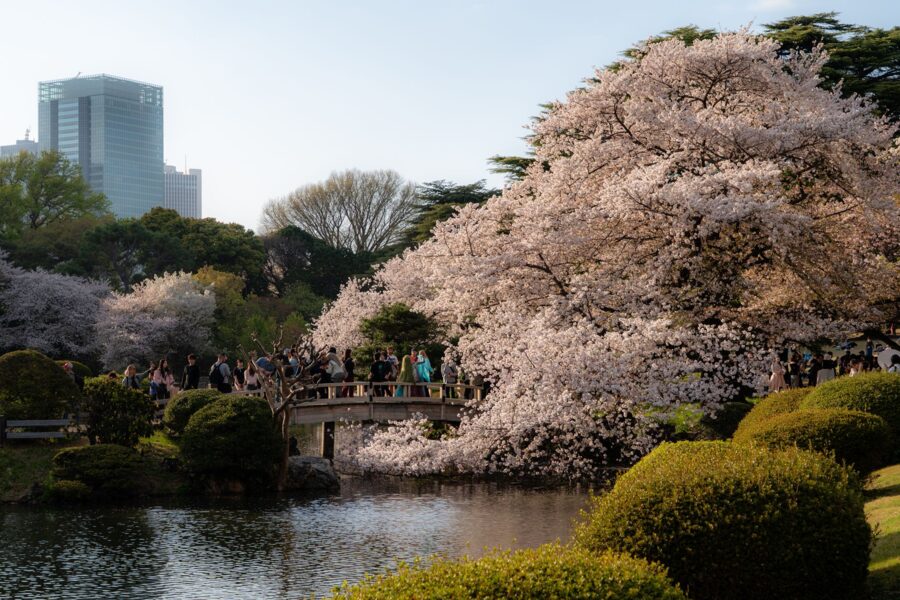
As of 2026 admission is ¥500 (about $3.30) for adults, ¥250 (about $1.70) for over-65s and students, and free for children of junior-high age and under. From 15 March it opens 09.00–18.00, last entry 17.30, and it stays open on Mondays from 25 March to 24 April; it warns that bloom weekends may need advance booking. Getting there: Shinjuku-gyoemmae Station (Marunouchi Line), exit 1, five minutes to the Shinjuku Gate.
The garden has a political footnote. The prime minister‘s annual Sakura wo Miru Kai (“party to see the cherry blossoms”) was held here until it was suspended after the 2019 row over how many of Shinzo Abe’s (安倍晋三) local supporters were on the guest list, a story from Japanese politics as much as from spring.
Meguro River
Not a place to sit. Cherry trees lean in from both banks of a narrow concrete channel for several kilometres below Ikejiri-Ohashi, and the stretch by Naka-Meguro Station fills with stalls and lanterns. It is a residential street; keep moving.
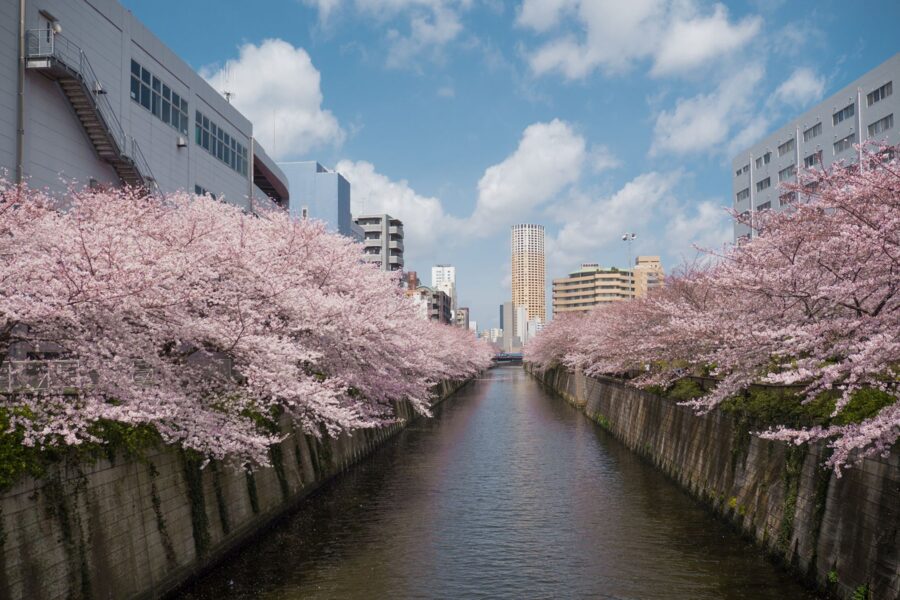
Getting there: Naka-Meguro Station (Tokyu Toyoko and Hibiya lines) for the busiest stretch. Mayor Aoki’s own tip is to come in the morning, or walk in from Ikejiri-Ohashi or Meguro Station.
Where to go: Kyoto
Maruyama Park
Kyoto’s party park sits behind Yasaka Shrine in Gion, laid out in the Meiji era by the garden designer Ogawa Jihei VII. At its centre is the Gion shidarezakura (祇園しだれ桜), a white weeping higan cherry. The present tree is the second of the name, tended by the 16th Sano Toemon, Kyoto’s best-known sakuramori (桜守, “cherry-keeper”).
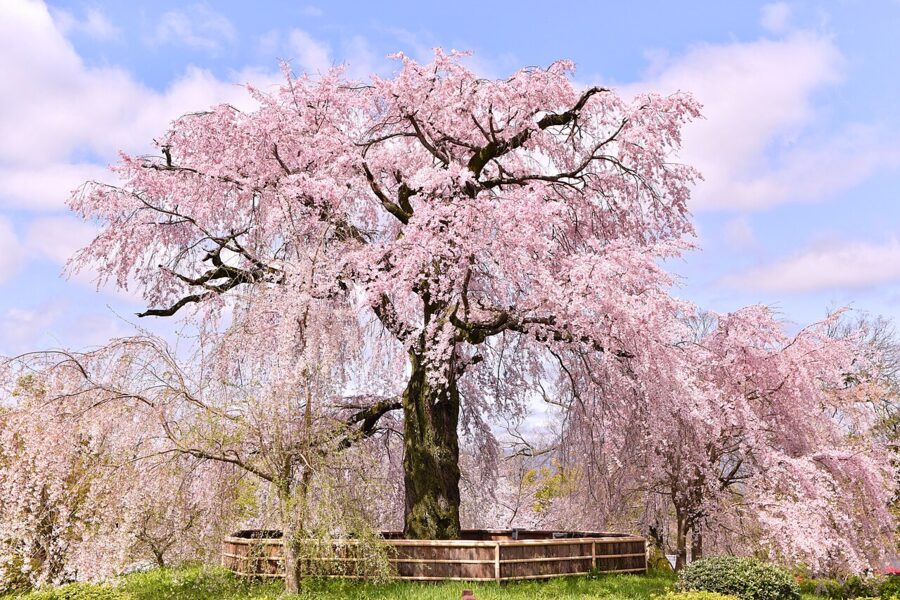

In 2026 the tree was lit from 24 March to 8 April, 18.00–22.00, according to the Kyoto City Tourism Association, with bonfires on some evenings unless a dry-air or wind warning was in force. Tea stalls and food stands open, and the ground under the trees fills with parties after dark.
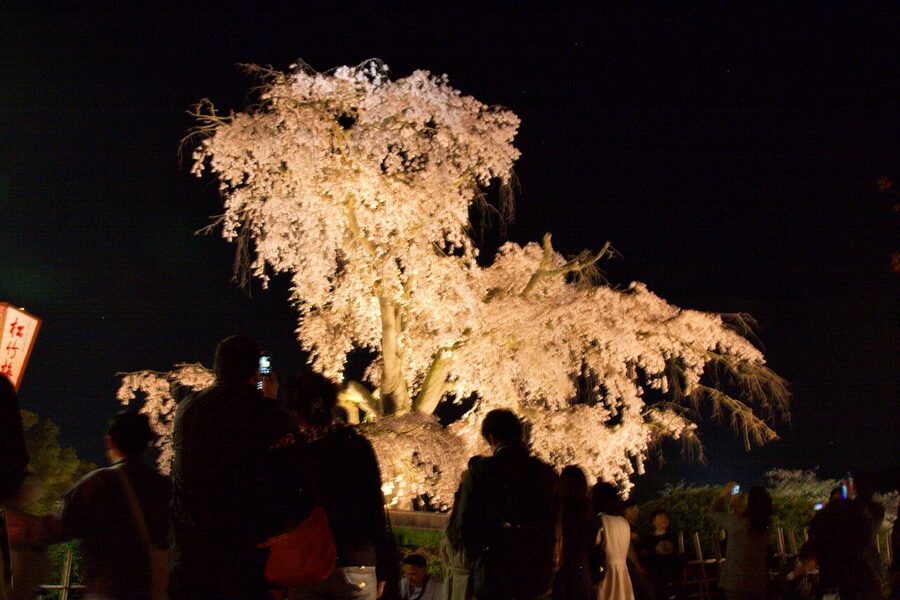

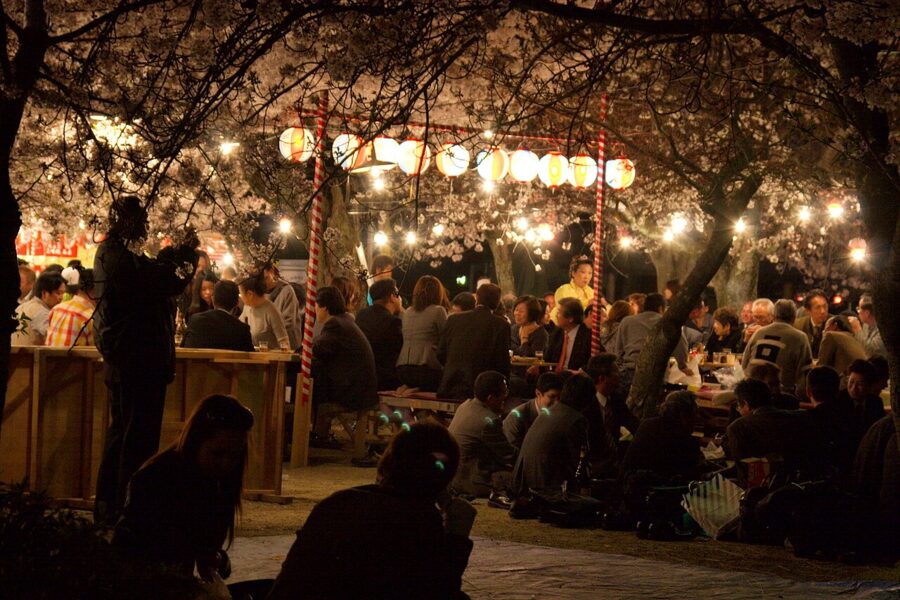

Getting there: Keihan Gion-Shijo Station, about 15 minutes on foot through Yasaka Shrine, or city bus 206 to Gion.
The Philosopher’s Path
The quiet one, if you go early. The path follows a branch of the Lake Biwa Canal for about 1.5 kilometres, from Ginkakuji Bridge to Nyakuoji Bridge, and is named for the philosophers Kitaro Nishida, Hajime Tanabe and their circle, who walked it in the Taisho era. Start at Ginkaku-ji before 08.00 and you will have most of it to yourself.
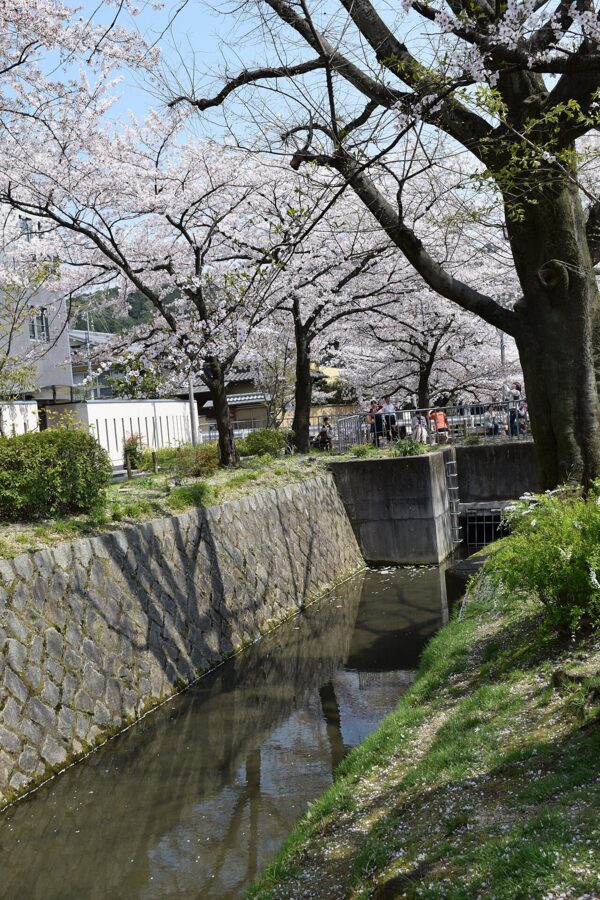

Daigo-ji, Hideyoshi’s hill, is a separate trip: Daigo Station on the Tozai subway line, exit 2, then about ten minutes on foot.
How a visitor joins in
You don’t need an invitation. The easiest hanami is the oldest: buy lunch and a drink at a convenience store, find ground where sitting is allowed, and sit. A small sheet costs a few hundred yen at a convenience store or hundred-yen shop. Bring a bag for your rubbish.
If a group near you waves you over, say yes, offer something from your bag, and expect a toast; “kanpai” will do. Shoes come off before you step on a sheet. Don’t sit on roots or pull down a branch for a photograph, and check the park’s last call for parties.
Timing matters more than place. Opening to full bloom in Tokyo took nine days in 2026, and the best week was the one after, until the rain. Watch the forecasters in early March, keep two evenings free, and treat every date above as a guide. Autumn has its own viewing, tsukimi, with dumplings and much less beer.
Next March someone from the Tokyo observatory will walk into Yasukuni Shrine, stand under one unremarkable tree and start counting. Five or six flowers, and the season is open. Somewhere across the city a new recruit will be told to buy a blue sheet.