
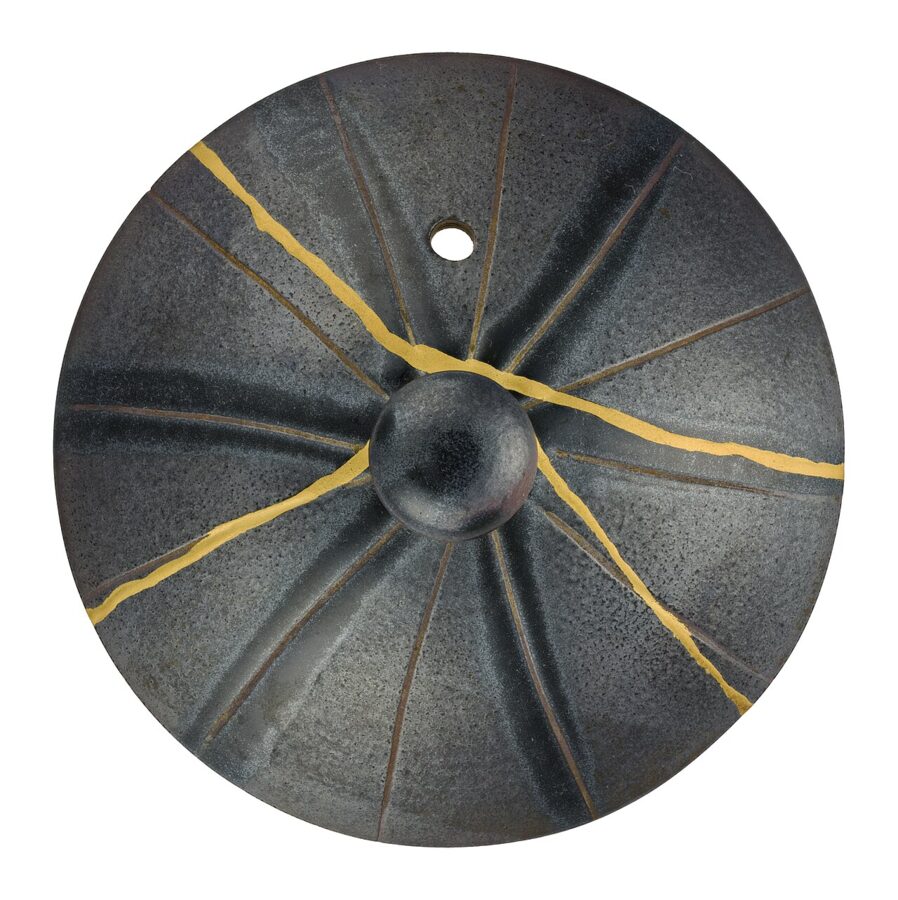

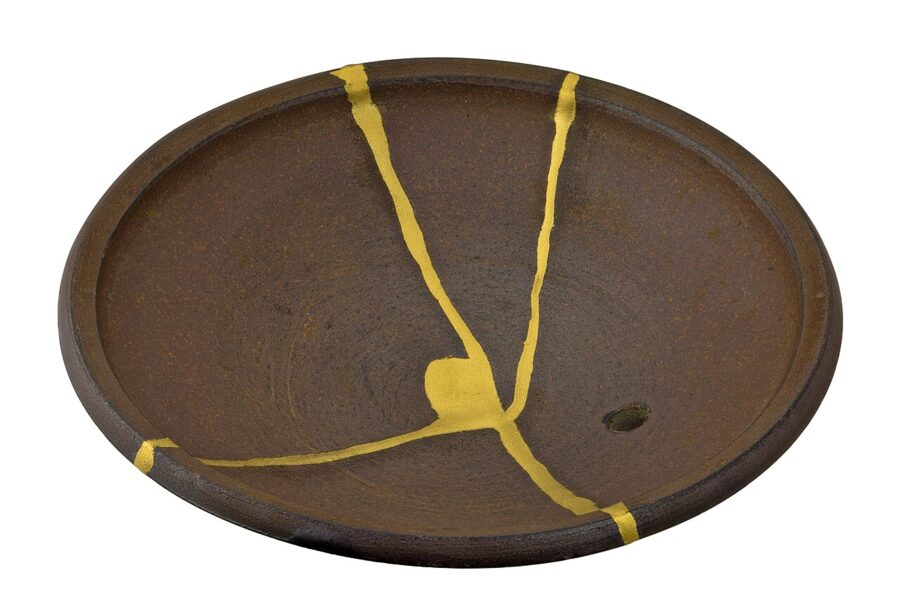
Hon’ami Kōetsu’s red Raku tea bowl came out of the kiln with cracks running from the rim down into the body. Nobody threw it away. The cracks were filled with lacquer and dusted with gold, and Kōetsu, the story goes, named the bowl himself: Seppō (雪峯), “snowy peak”, the white glaze for the snow on the summit and the gold lines for the meltwater coming down.
Four centuries on, Seppō is an Important Cultural Property in a museum in Shirokanedai, Tokyo, and the gold in its cracks is the reason people come to look. That habit of turning a repair into the view is what Japanese calls kintsugi. It is older, slower and more practical than the posters suggest.
In this article
The word: kintsugi, kintsukuroi and the seam as scenery
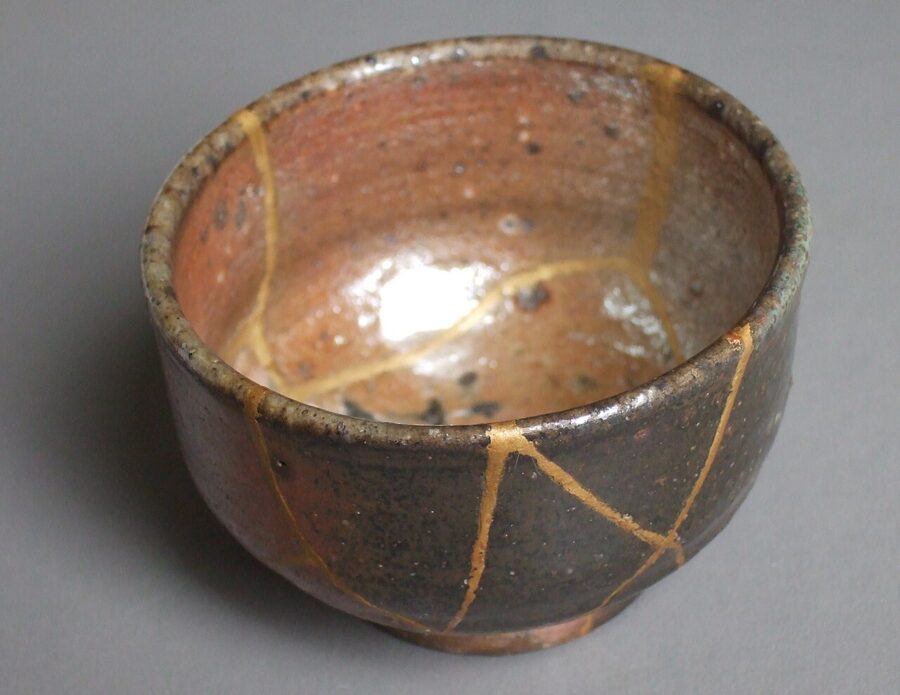
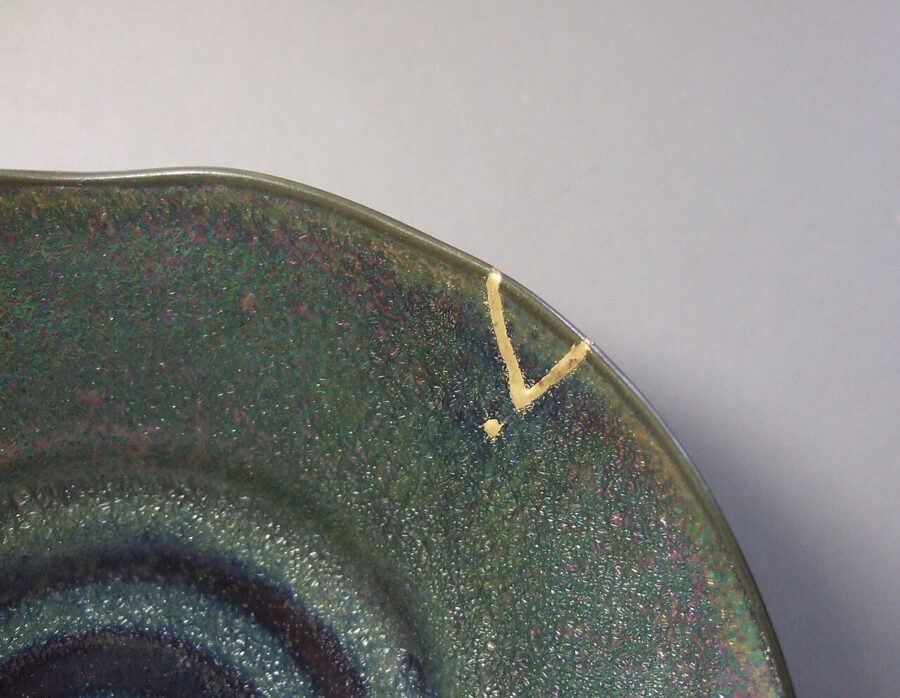
金継ぎ joins kin (金, gold) to tsugi (継ぎ), from tsugu, to join or splice, the same verb you use for taking over a family business. Say it in three even beats, kin-tsu-gi, with the “tsu” of tsunami. The Daijisen dictionary defines it as gluing broken ceramics with urushi lacquer and sprinkling the seam with gold, silver or platinum powder. It adds the detail that matters: the finished seam is called a keshiki (景色, “scenery”), enjoyed for a character the piece did not have before it broke.
The dictionary’s second name, kintsukuroi (金繕い, “gold mending”), is the older form. Sixteenth- and seventeenth-century tea records speak of tsukuroi (繕い, mending) and urushi-tsugi (漆継ぎ, lacquer joining), and the Cambridge librarian Hiroko Roberts-Taira, writing in a Japanese recycling journal in 2025, notes that the word kintsugi does not appear in the tea books of Sen no Rikyū’s time. A 1724 entry in Kaiki, the physician Yamashina Dōan’s record of the regent Konoe Iehiro’s talk, praises a bamboo vase for its “black mending and gold mending”.
When kintsugi itself became everyday Japanese is harder to pin down, and I found no one who has dated its first printed use. Roberts-Taira, who grew up in the 1970s and 1980s, remembers it as an unfamiliar word then. The Oxford English Dictionary added it in 2024.

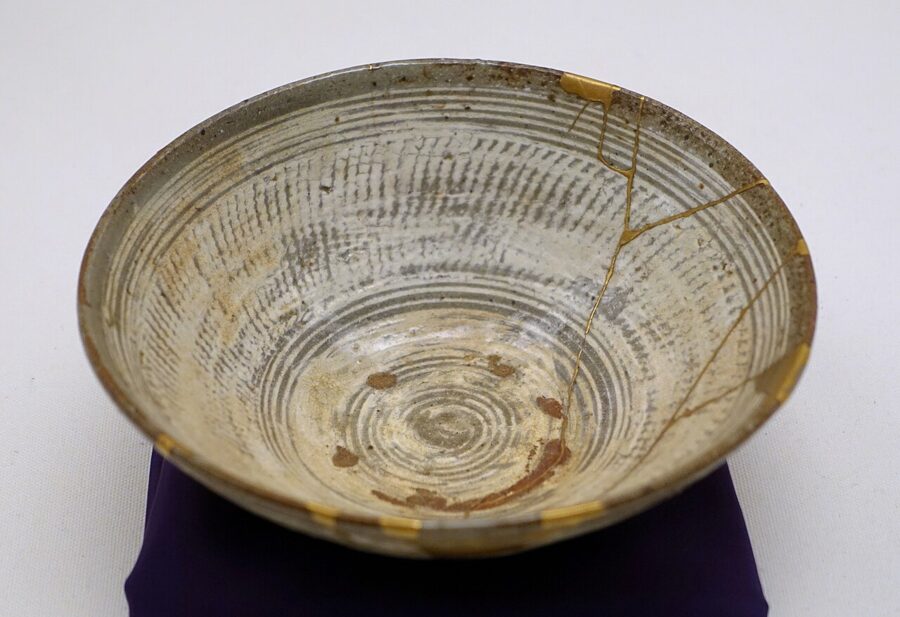
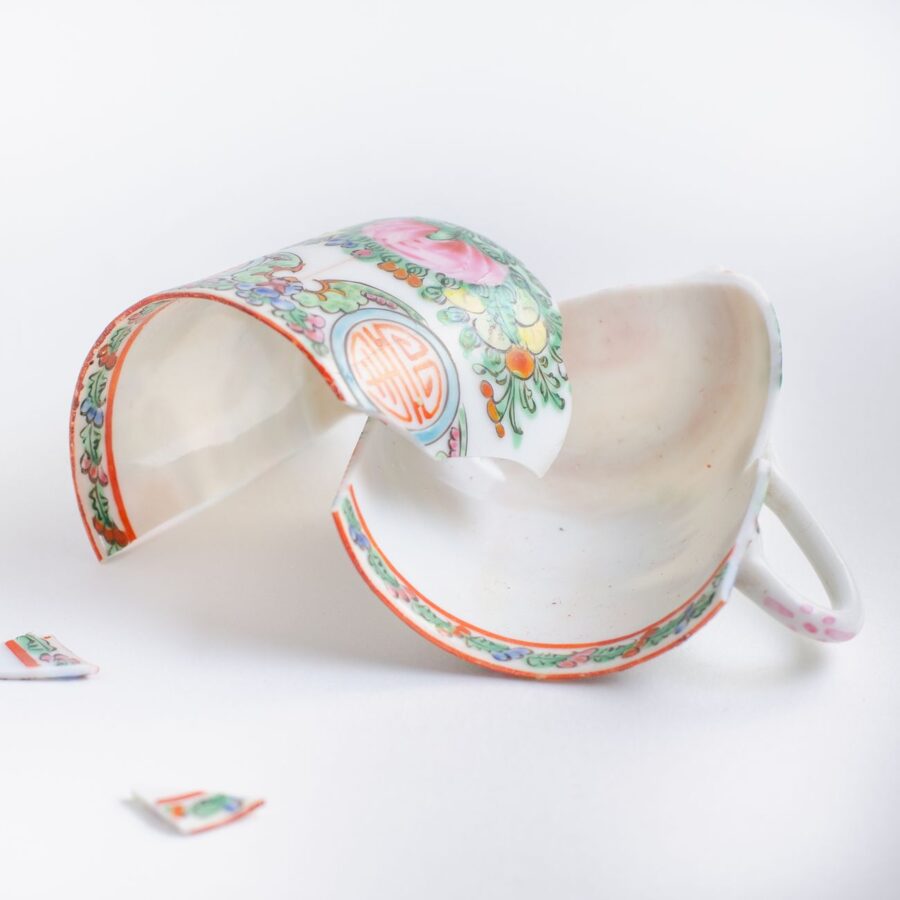
Two related words turn up in every repair shop. Yobitsugi (呼び継ぎ, “called-in joining”) fills a gap with a shard from a different pot, so a blue fragment can end up in a white bowl. Tomotsugi (共継ぎ) means patching a plate with pieces of its broken twin in the English books, but Tsugu Tsugu, a Tokyo repair business with shops in Ebisu and Asakusa, uses it, with tomonaoshi (共直し), for a repair coloured to match the glaze.
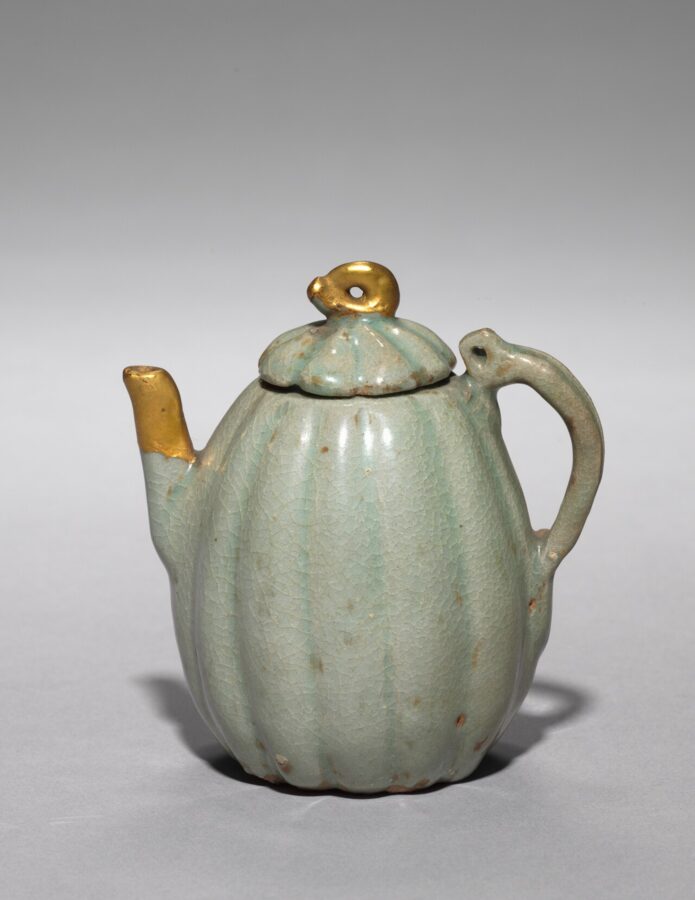
The gold was never compulsory. Surviving pieces show silver, black lacquer and red lacquer as well, and some old Kutani and Imari wares were simply glued. The repair came first; the gold was a choice about how loudly to show it.

How a repair is actually done
The lacquer comes from a tree
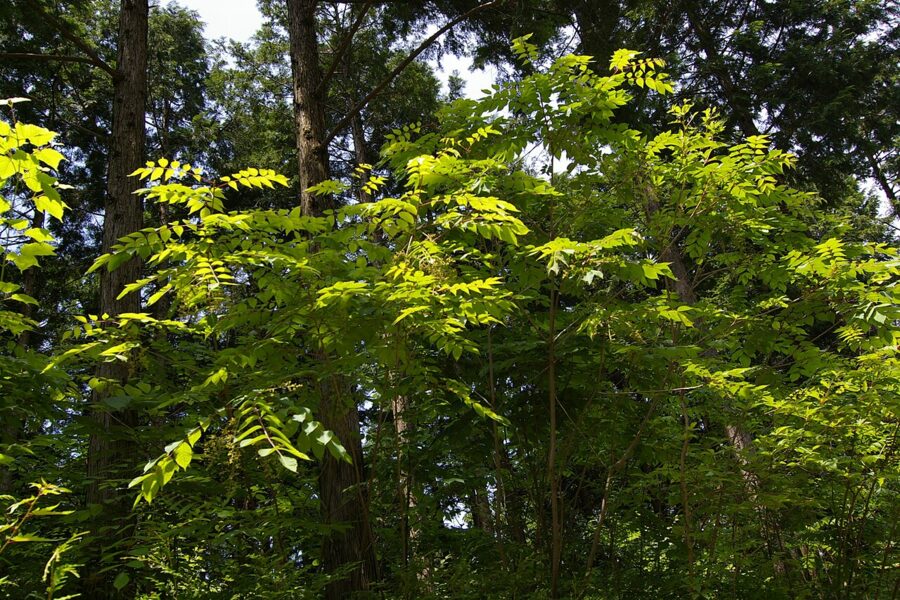
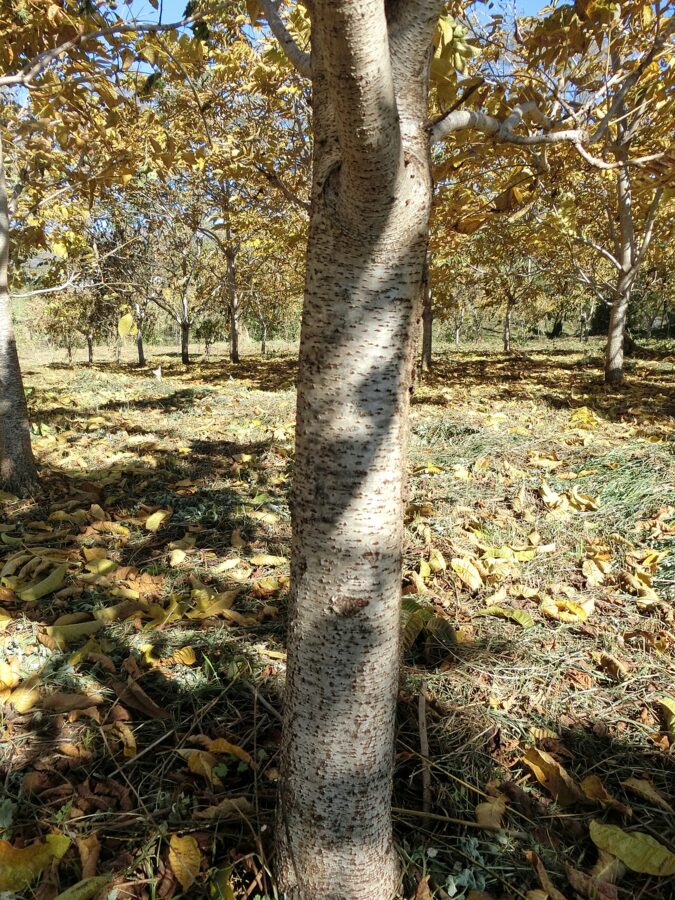
Urushi (漆) is the sap of Toxicodendron vernicifluum, the lacquer tree, which tappers score from early summer into autumn. It does not dry the way glue does: an enzyme in the sap, laccase, uses moisture from the air to make its urushiol set hard, so it cures best in warmth and humidity and barely at all in dry air.
Almost all of it is imported. The Forestry Agency’s forestry white paper published in June 2026 puts Japan’s urushi consumption in 2024 at 31.2 tonnes and domestic production at 1.8 tonnes, about 5.7%, mostly from Iwate and a handful of other districts. Since 2014 the Agency for Cultural Affairs has required Japanese lacquer, as a rule, for repairs to National Treasure and Important Cultural Property buildings.

Glue, fill, sand, then gold
A traditional repair runs to ten or more operations, and each ends with the piece going into a muro (室), a closed cabinet kept warm and damp. Tsugu Tsugu gives the target as 20–30°C and 70–85% humidity. Between stages you wait.
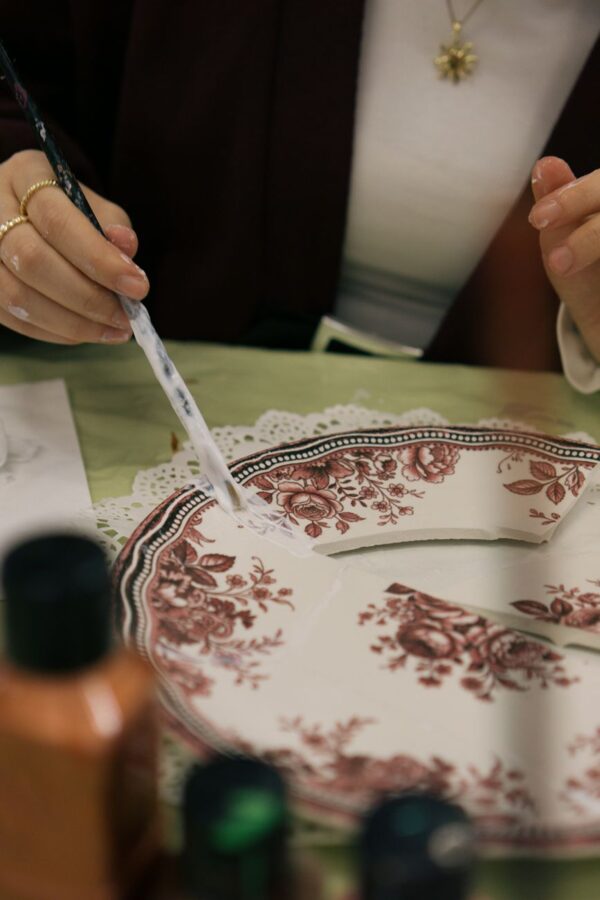
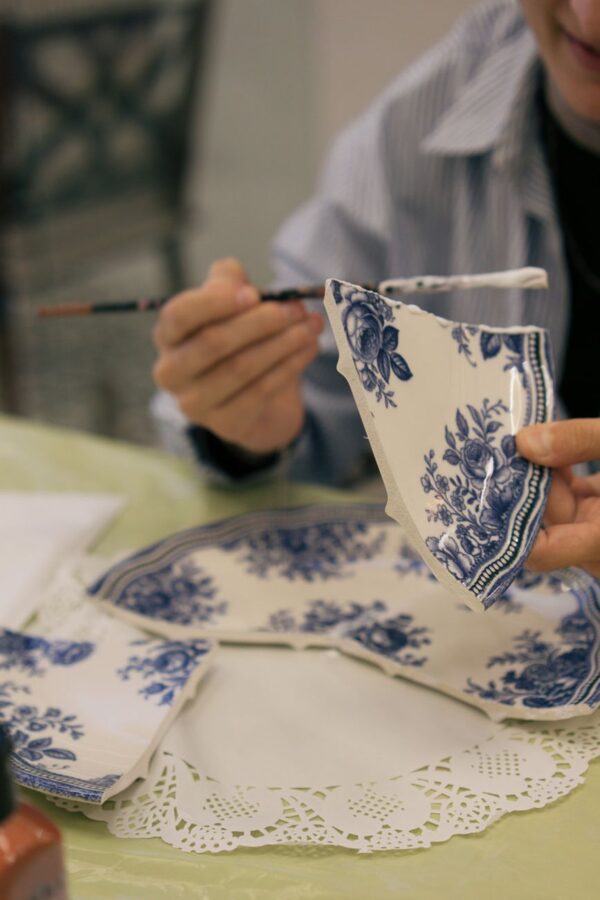
- Glue. The edges are coated with mugi-urushi (麦漆), wheat flour worked with water to the firmness of an earlobe and mixed with about as much raw lacquer. The pieces are pressed together, taped and left for a week or two.
- Fill. Missing chips are built up with kokuso (刻苧), lacquer thickened with wood powder and chopped hemp. Fine gaps are levelled with sabi-urushi (錆漆), lacquer mixed with powdered clay.
- Sand and coat. Each layer cures, is rubbed smooth with whetstone or abrasive paper, and is coated in black or red lacquer, often several times.
- Gold. A thin line of red bengara lacquer goes along the seam. When it is just tacky, gold powder is dusted on with silk floss or a soft brush, then fixed with another wipe of lacquer.
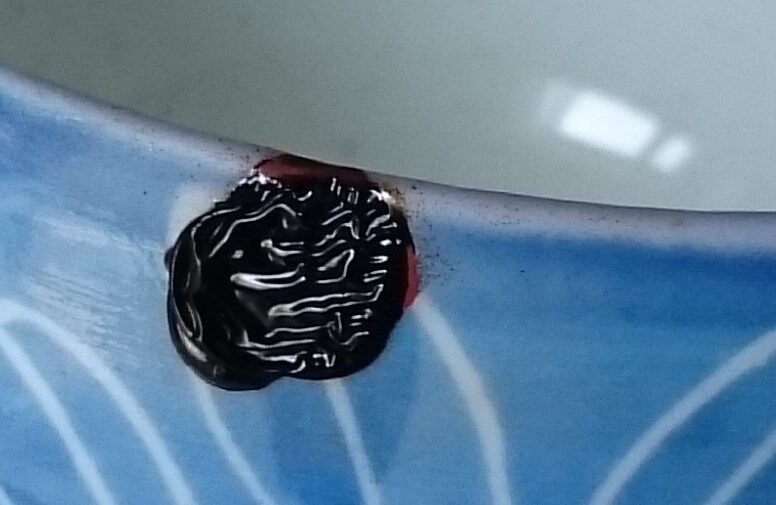

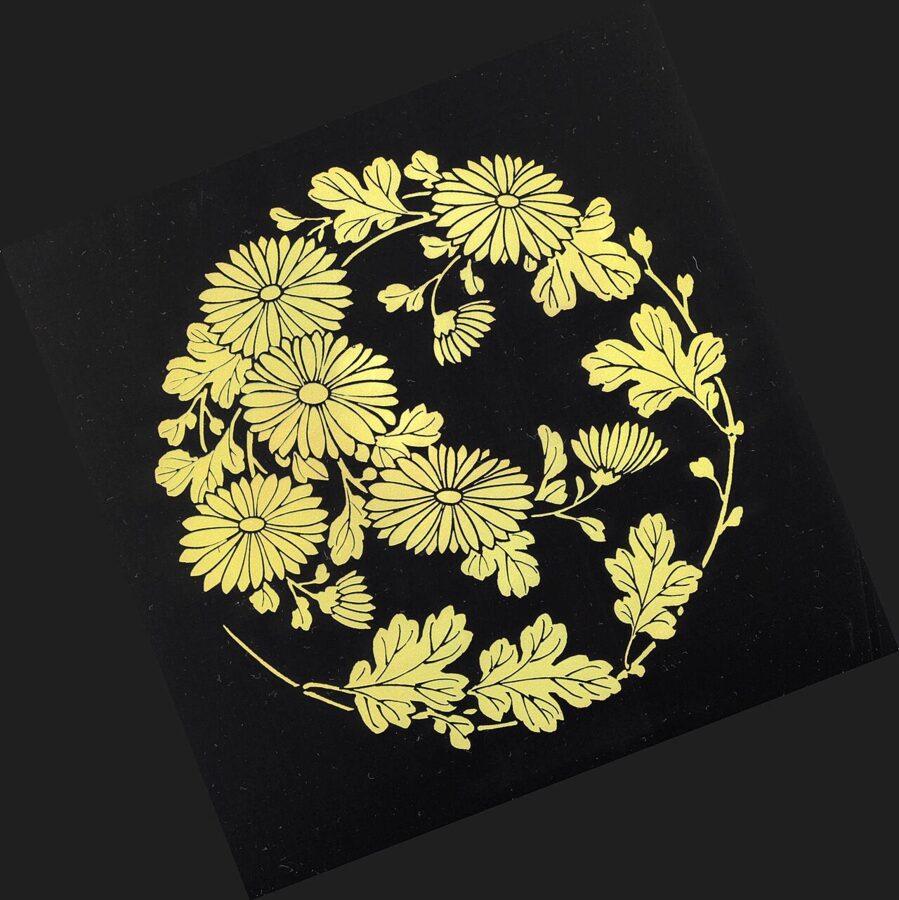
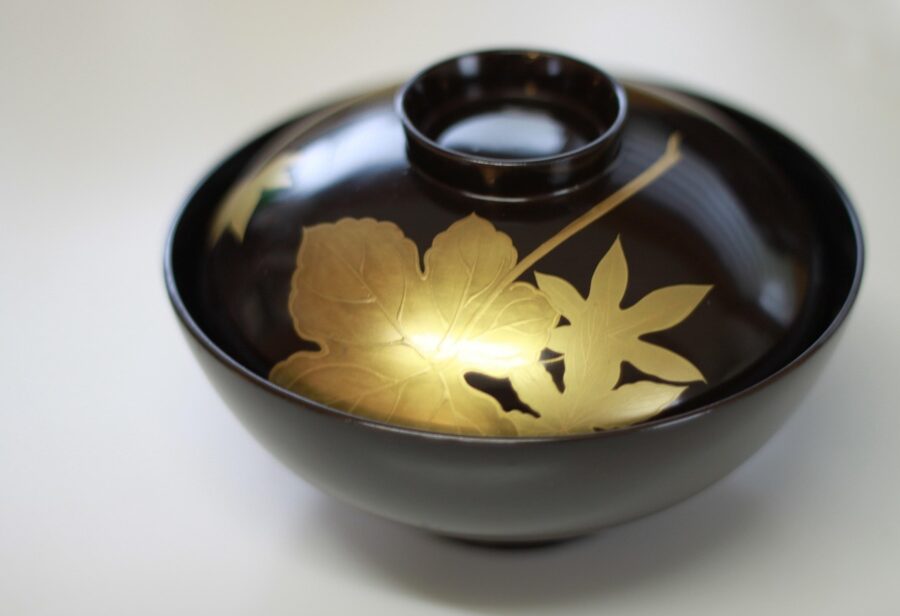
The gold comes in two main grades. Keshifun (消粉) is beaten so fine it is almost dust and gives a soft matt line; marufun (丸粉) is tiny round grains, bedded in and polished, brighter and harder-wearing. Both come from maki-e (蒔絵), the sprinkled-gold decoration on lacquerware, and many repairers trained as lacquerers first.


A straightforward break takes two to three months from first glue to last polish. Tsugu Tsugu tells students who want to repair one bowl entirely in its classes that they need to be in Japan for about that long.
Kintsugi is mostly waiting: a week for the glue, more weeks for the filling, and a day in a damp box for the gold.
Why urushi gives you a rash
Urushiol is the same kind of compound that makes poison ivy blister. Heibonsha’s encyclopedia says plainly that urushi-kabure (漆かぶれ), urushi rash, comes from urushiol, which sets up an allergy in some people. Wet lacquer on bare skin can bring up an itching, weeping rash a day or two later, so beginners work in gloves from the first lesson.
Cured lacquer is inert, which is why a finished urushi repair is safe to eat from. Professionals glove up too, though many say they built a tolerance over the years. The government’s English magazine Highlighting Japan reported in 2020 that because urushi irritates the skin, the kintsugi teacher Kunio Nakamura uses a plant-based resin in workshops that draw overseas students.
Gold powder, brass and the kits
Much of what is sold as kintsugi uses no urushi at all. Japanese repairers call it kan’i kintsugi (簡易金継ぎ), “easy kintsugi”: epoxy or superglue for the join, a synthetic coating such as cashew-based shin-urushi (新うるし) on the seam, and brass powder or gold-coloured mica instead of gold. It sets in hours, not weeks.
The catch is the dinner table. Since June 2025 Japan’s food sanitation rules have allowed only listed synthetic materials in things that touch food, and some kits warn against eating from the result. Even Tsugu Tsugu notes that its brass finish is not certified food safe. If the bowl will hold soup, it needs lacquer and real gold or silver.
What a professional repair costs
Tsugu Tsugu, which says it handles more than a thousand repairs a year, publishes a detailed price guide. As of November 2026 it lists these starting prices for urushi work finished in fine gold powder, set by the damage, not the size of the dish.
| Damage | From |
|---|---|
| Minimum charge | ¥3,300 (about $22) |
| Chip under 0.5 cm | ¥3,300 |
| Chip under 2 cm | ¥5,500 (about $37) |
| Crack under 4 cm (added to other work) | ¥2,200 (about $15) |
| Dish broken in two, 18 cm break | ¥20,900 (about $140) |
| Dish in four pieces, 25 cm of breaks | ¥30,800 (about $210) |
In September 2025 the shop’s average job was in the ten-thousand-yen range, about $67 upward. Polished marufun adds about half again, and a colour-matched finish adds ¥3,300 per colour. It takes work by appointment at its Ebisu and Asakusa shops, by post, and at Muji’s Shinjuku-dori store for a ¥550 (about $3.70) drop-off fee; ask about the queue first.
History: staples, tea men and glass menders
Lacquer repair in Japan is far older than tea. Roberts-Taira points to pottery from the Shimo-yakebe site in Higashimurayama, western Tokyo, glued with lacquer three to four thousand years ago. What tea added was the idea that a mend could be looked at.
The Bakōhan bowl, and what it actually shows
The most-told origin story is about a bowl that was not mended with gold. The Tokyo National Museum’s celadon bowl named Bakōhan cracked while the shogun Ashikaga Yoshimasa owned it; he sent it to China for a replacement, and it came back held by metal staples that looked like a large locust, which made it more famous than before. I have told it at more length in the piece on wabi-sabi.
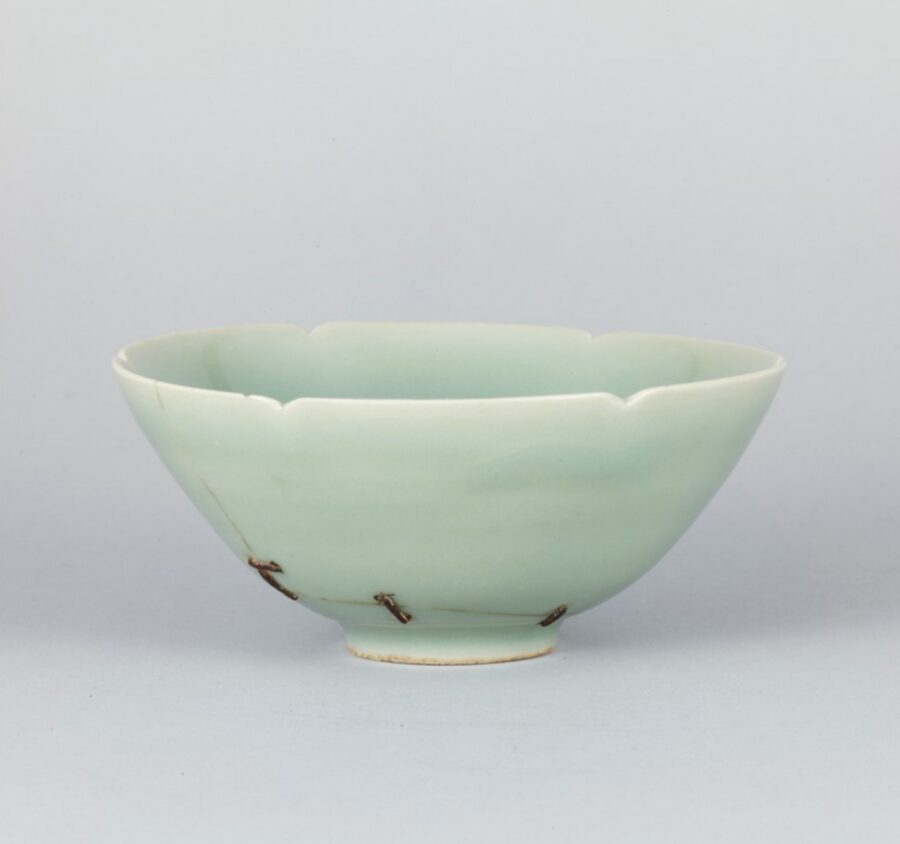
The only written source is the Bakōhan Saōki, an account by the Confucian scholar Itō Tōgai dated 1727, nearly 240 years after Yoshimasa died. Yukiko Iwao, a curator at the Museum of Oriental Ceramics in Osaka, found in a government-funded study that tea writers of that decade were still arguing about staples: Kaiki, in 1727, calls stapling a ceramic vase hard to understand. The bowl is often presented as the birth of kintsugi; the record supports something narrower, that by the eighteenth century a visible repair could raise a bowl’s value.
Tea men and their broken things
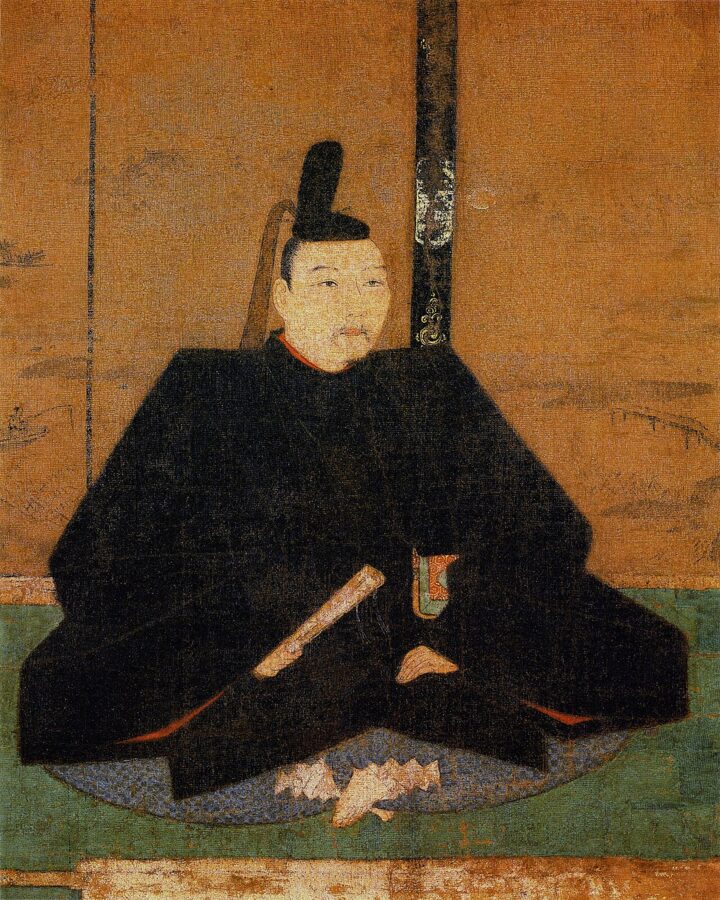
Iwao traces the shift to the mid-sixteenth century, when records of tea gatherings begin to describe repairs in coloured lacquer that stand out from the pot. The Hakata merchant Kamiya Sōtan’s diary, from 1586, keeps noting pieces iro-urushi nite tsukuroi ari, “mended in coloured lacquer”. The tea men were not hiding the damage.
The Yamanoue Sōji Ki records a famous tea jar, Mikazuki, that broke into six pieces in fighting at Takaya Castle in Kawachi. Sen no Rikyū had it rejoined, and it was valued at five to ten thousand kan afterwards, before passing to Oda Nobunaga and burning at Honnōji in 1582. The Ido bowl Tsutsui-zutsu survives in five lacquered pieces: tradition says Toyotomi Hideyoshi’s page dropped it, and Hosokawa Yūsai saved the boy with a quick verse.
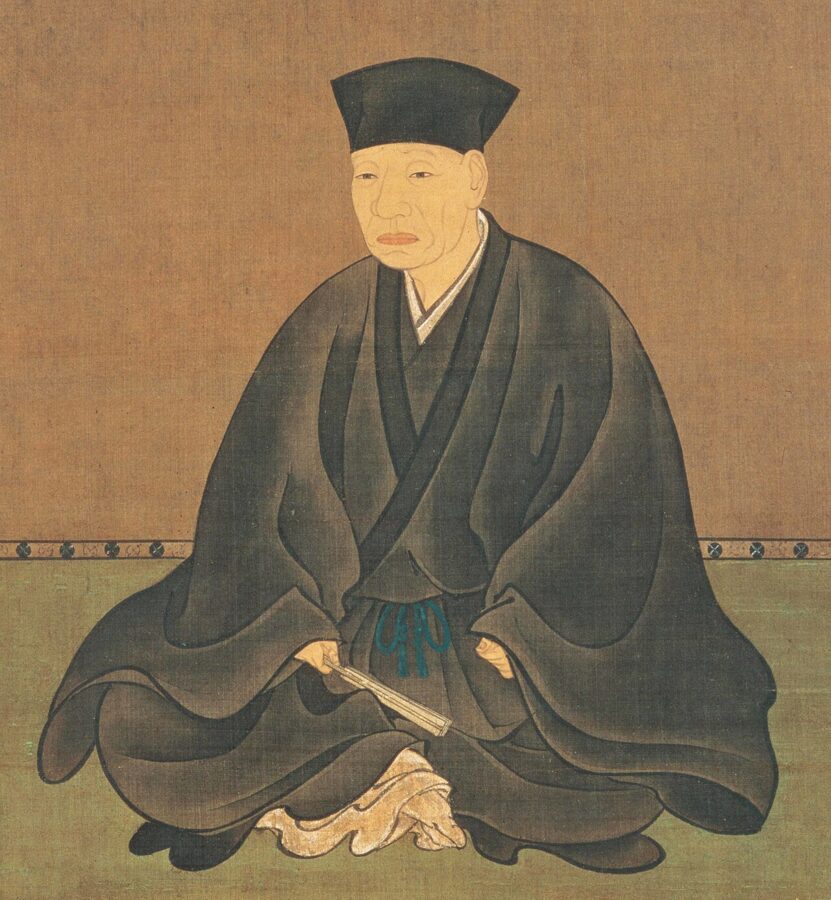
Seppō is the rare early piece where the potter and the gold repair can be put together, and Roberts-Taira suggests gold mending in tea may date from Kōetsu’s time, the early Edo period. Tea men were also cutting bowls on purpose by then. The Mitsui Memorial Museum’s Ido bowl Shumi, also called Jūmonji (“cross”), was cut down and rejoined by the tea master Furuta Oribe, according to a 1727 account, and its cross-shaped seams gave it the second name.
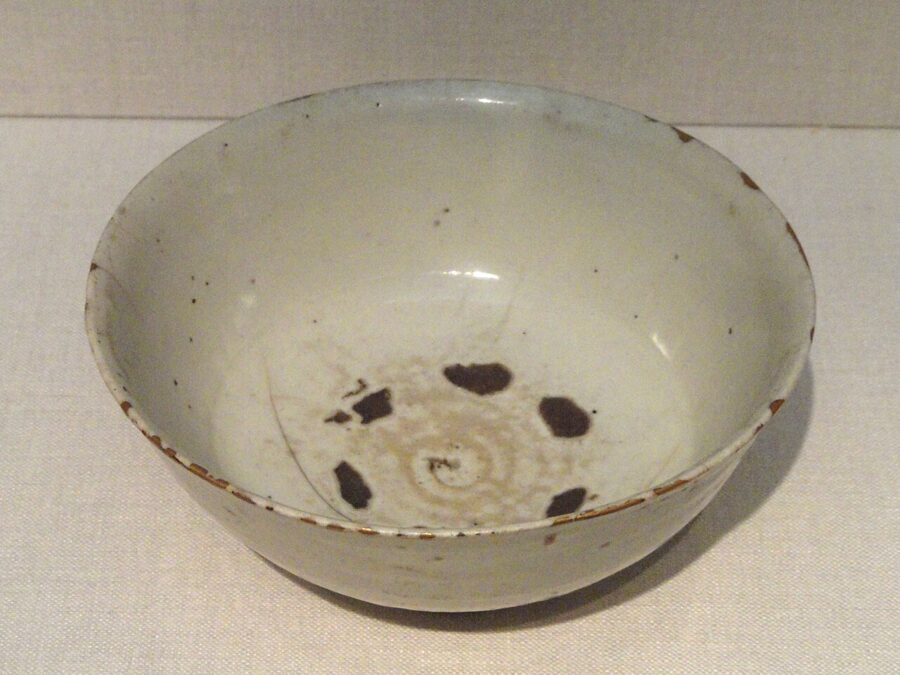
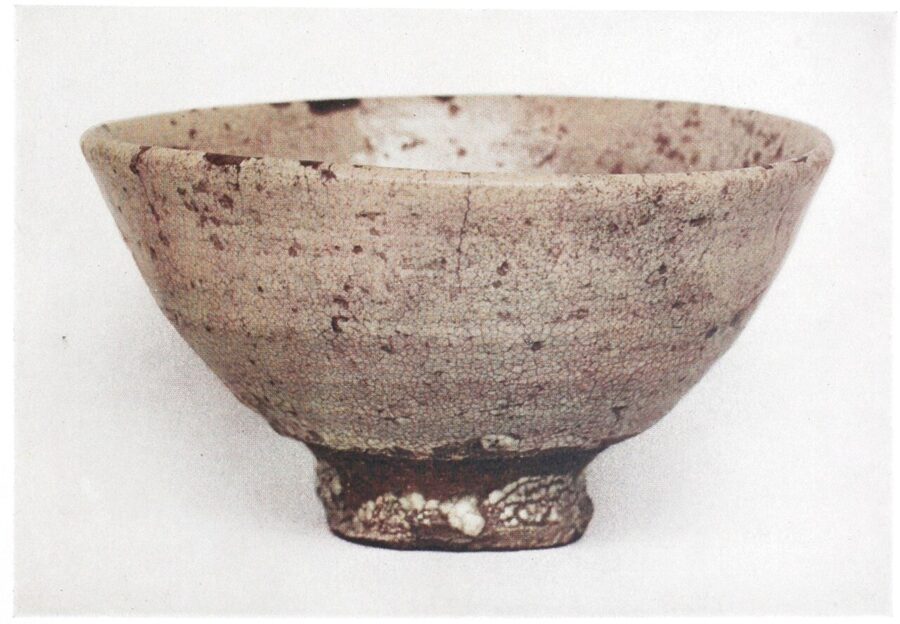
Not everyone approved. The Chafu, a tea book of the late 1600s, mocks Kanamori Sōwa for clamping tea wares with silver staples, fussy as a lady’s accessories. Iwao concludes that today’s warm view of visible repair does not simply carry forward the values of Rikyū’s tea; it was built up over two more centuries of changing taste.
Edo’s glass menders
For ordinary households, gold was out of reach. From the 1790s, street menders called yakitsugi-ya (焼継屋) joined crockery with powdered lead glass and a quick firing. Kitagawa Morisada’s notebook of city life, begun around 1853, explains the split: everyday dishes got glass, while tea wares and valuable pieces, which nobody wanted back in a kiln, were mended in lacquer and finished with gold.
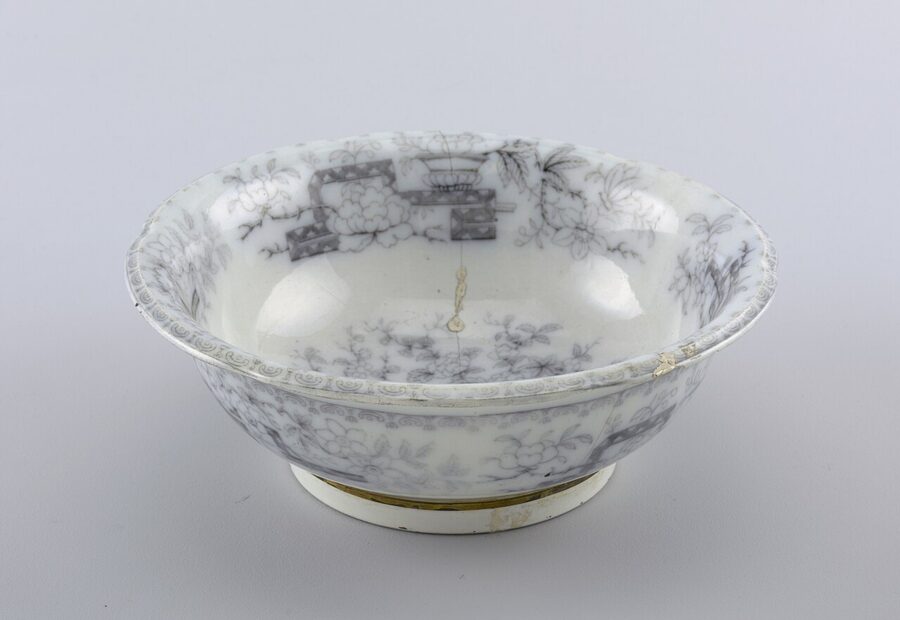
Excavations at the Owari Tokugawa clan’s former residence in Shinjuku turned up a blue and white dish glued by the cheap glass method, then painted with red lacquer and gold leaf to pass as a gold repair. Even in Edo, people wanted the look. Factory-made crockery had put the glass menders out of business by the middle of the Meiji era.
“Embrace your flaws”: how the metaphor reads in Japan
In English, kintsugi now mostly means grief, resilience and self-acceptance: hospital blogs, therapists, a basketball court in Los Angeles filled with gold resin. The Oxford English Dictionary gives it a second sense, an outlook that treats breakage and healing as part of life. Christian writers use it too; the painter Makoto Fujimura, trained in Japanese mineral-pigment painting, treats it as an image of grace.
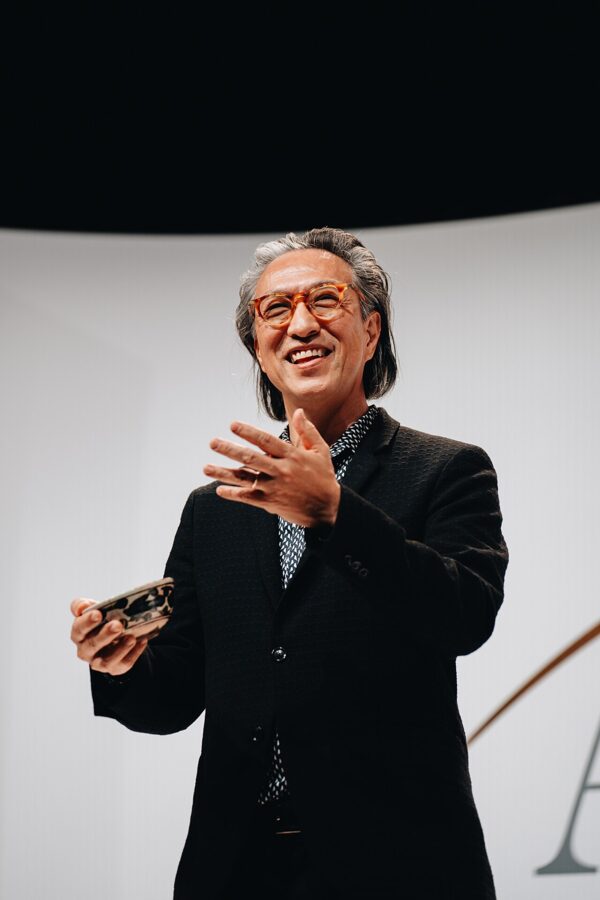
In Japan the craft and the slogan sit further apart. Roberts-Taira tells Japanese readers that the usual understanding at home is plain: kintsugi mends a thing and keeps the memories tied to it. In Britain she found kits printed “perfectly imperfect” and a 2022–2024 hospital project that put gold on photographs of people’s scars, and her first reaction was that this stretched kintsugi too far.
The memories part has a date. After the 2011 earthquake and tsunami, Japanese coverage of kintsugi filled with phrases about joining memories, and Nakamura ran workshops for people mending pottery broken in the disaster. One participant wrote that the repair had healed not only the memento but the writer too: a metaphor, but about one object and one loss.
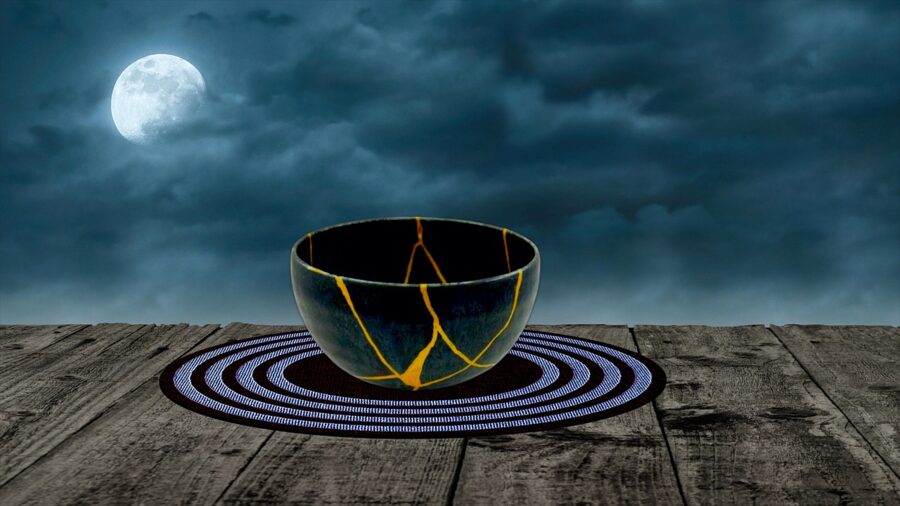
I would read the export as a translation that kept the gold and dropped the lacquer. “Embrace your flaws” turns the bowl into you; in a Japanese workshop the bowl stays a bowl, and the virtue is patience and a refusal to waste, closer to mottainai (もったいない, “what a waste”), one of the everyday Japanese customs, than to therapy. It shares an airport shelf with ikigai, and changed on the journey in much the same way.
The export kept the gold and dropped the lacquer.
Japanese people often ask whether a mended bowl is lucky. Nothing in the dictionaries or tea records makes it a charm; they record only that a good mend made a bowl more interesting to look at. As for how hard it is to learn: the gluing is easy, the timing is the skill.
Learning it, or handing it over
Kintsugi classes run all over Japan, but the ones a visitor can book in English centre on Tsugu Tsugu, with studios in Ebisu and Asakusa and, since 1 November 2026, a shop in an old house in Higashiyama, Kyoto. Its workshop page sets out the options as of November 2026.
- Traditional workshop, 90 minutes, ¥22,000 (about $150). Real urushi and 23-carat gold on a dish prepared in advance: you do one intermediate step, then dust the gold, and take the piece home in a drying box. Ages 13 and up.
- Kintsugi-style workshop, 60 minutes, ¥6,600 (about $44). Epoxy and brass for ornaments, not tableware; the shop suggests it for anyone sensitive to urushi.
- Regular classes, 90 minutes. Your own pieces, over months: ¥9,900 (about $66) a class for short stays, or from ¥4,950 (about $33) on a ten-class ticket, plus registration, storage and a ¥9,800–22,000 (about $65–150) kit.
The Kyoto shop opens 10:00–18:00, closes on Wednesdays and displays more than a hundred mended pieces for sale, a good way to compare finishes before you commit a bowl of your own. It is in a quiet lane in Komatsu-cho, near Kenninji. The Asakusa studio is in the Kaminarimon district, handy if you are already exploring the older Tokyo neighbourhoods east of Ueno.

Where to see mended bowls
The famous pieces are shown in rotation, so check each museum’s exhibition list before you go. None of the dates below promises a particular bowl.
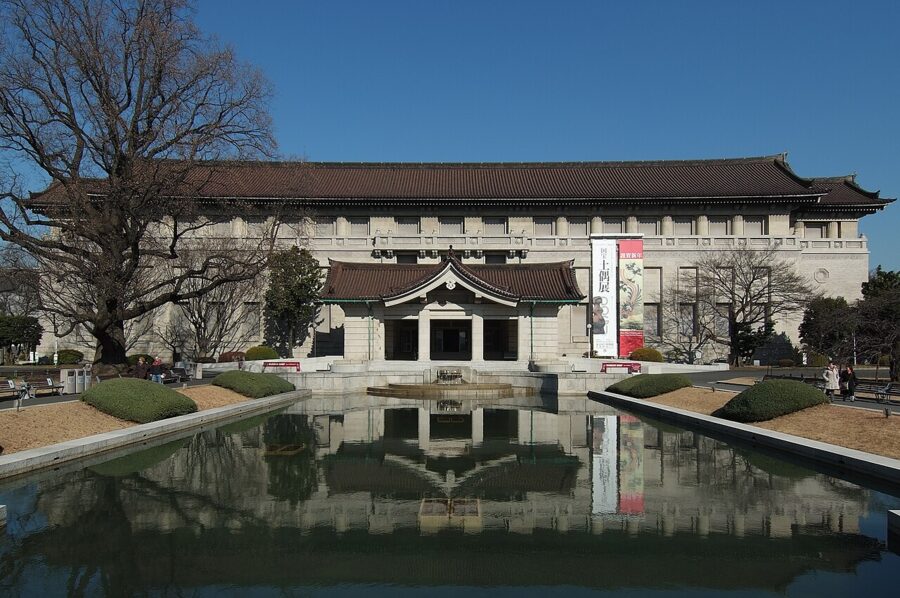
Tokyo National Museum, Ueno. Home of the Bakōhan, shown now and then, and of many tea wares with lacquer repairs. Collection galleries cost ¥1,000 (about $6.70) for adults as of November 2026 and open 9:30–17:00, until 20:00 on Fridays and Saturdays, closed Mondays. The Honkan’s tea gallery, Room 4, is closed for maintenance until 25 April 2027; visitor information is in English.

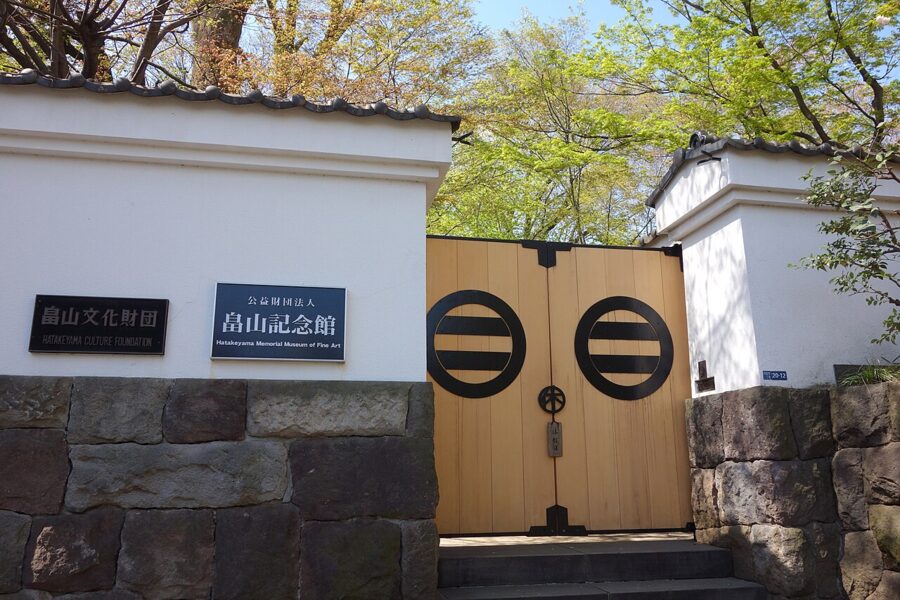
Ebara Hatakeyama Museum of Art, Shirokanedai. The industrialist Hatakeyama Issei’s tea collection, Seppō included, shown in four exhibitions a year. It opens 10:00–17:00 (last entry 16:30), closes on Mondays (Tuesday after a holiday Monday) and takes no cash. The current show of imported tea wares runs until 13 December 2026; the next opens on 16 January 2027.
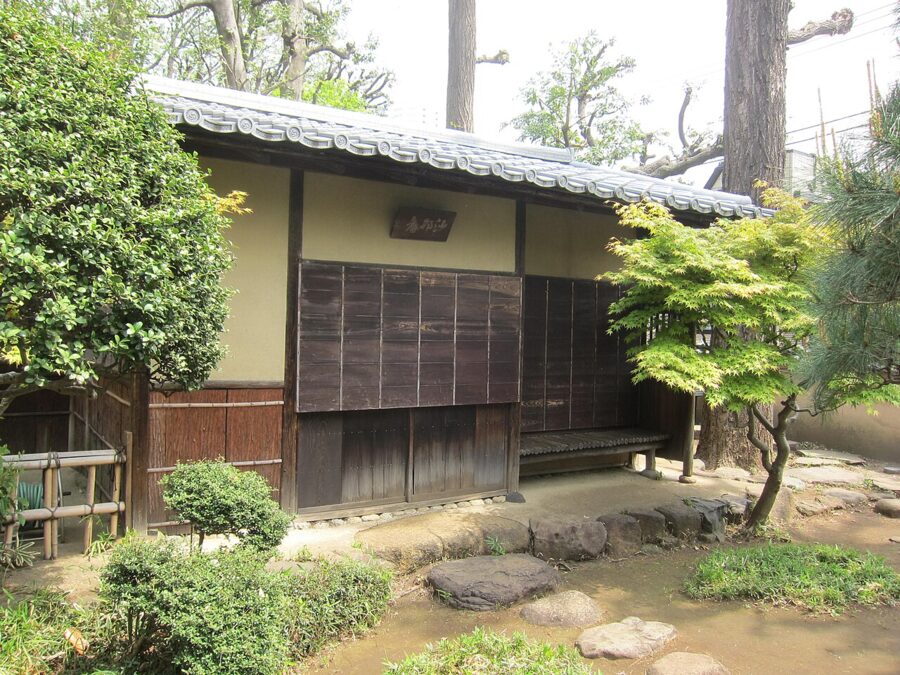
Mitsui Memorial Museum, Nihonbashi. The Mitsui family’s collection, the Shumi (Jūmonji) bowl among it, on the seventh floor of the Mitsui Main Building, entered from the Nihonbashi Mitsui Tower atrium. It opens 10:00–17:00; the next exhibition runs 12 December 2026 to 30 January 2027.
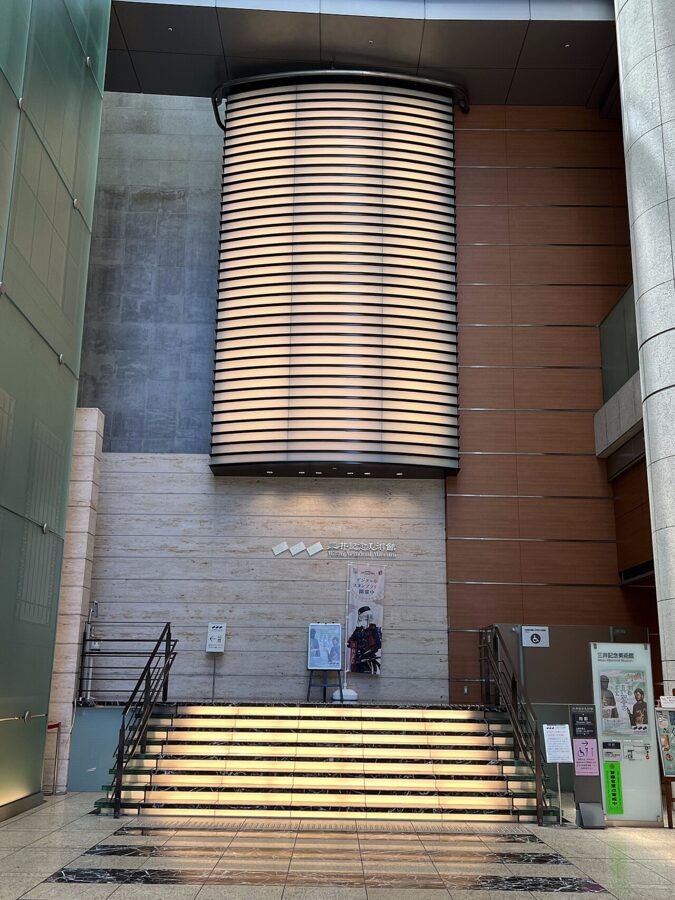
Getting there.
- Tokyo National Museum: 10 minutes’ walk from JR Ueno or Uguisudani Station.
- Ebara Hatakeyama Museum of Art: 2-20-12 Shirokanedai, Minato; 5 minutes from Takanawadai Station (Toei Asakusa Line), exit A2 (stairs only), or 10 minutes from Shirokanedai Station (Namboku and Mita lines), exit 1 (access page).
- Mitsui Memorial Museum: 2-1-1 Nihonbashi Muromachi, Chuo; 1 minute from Mitsukoshimae Station (Ginza and Hanzomon lines), exit A7 (access page).
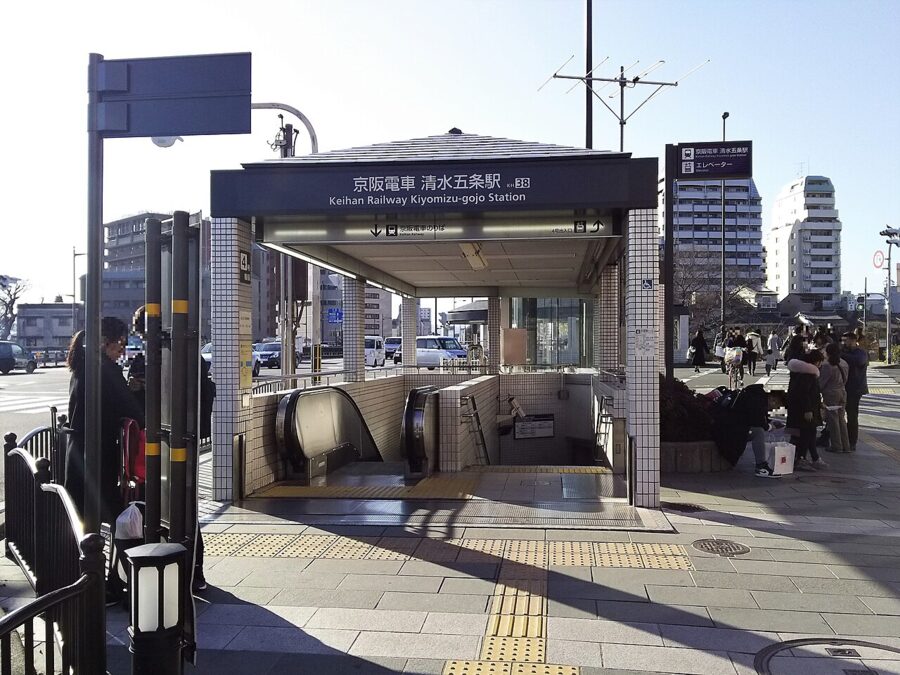
- Tsugu Tsugu Kyoto: 572-15 Komatsu-cho, Higashiyama; about 10 minutes from Kiyomizu-Gojo Station (Keihan Main Line).

If Seppō is out when you visit, look at the cracks before the glaze. Kōetsu saw a mountain in a kiln accident, and the lacquerer who filled it made the snowmelt shine.